
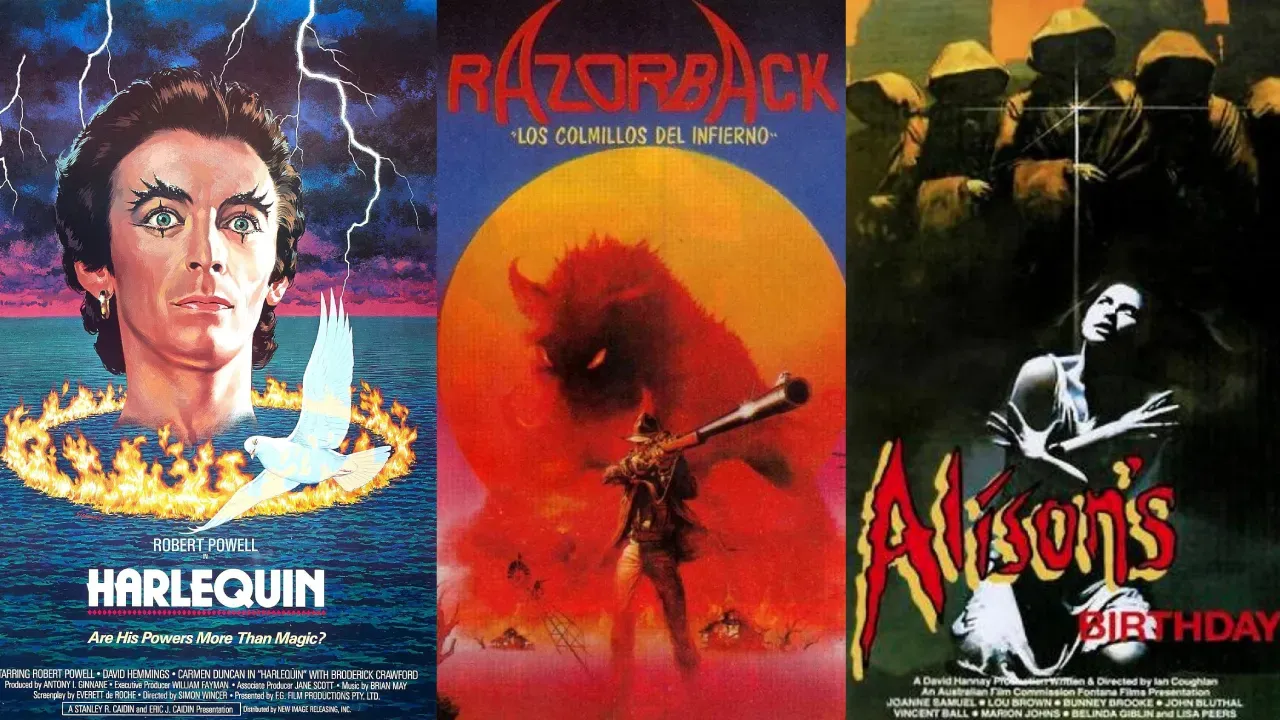
Where to Watch Best “Ozploitation” Films: 80s Horror/Thrillers – Part 1
Discover where Best “Ozploitation” Films: 80s Horror/Thrillers – Part 1 is available to stream, rent or buy across different platforms and countries.
We're sorry, no streams available for Best “Ozploitation” Films: 80s Horror/Thrillers – Part 1.
Why I made the list:
After exploring the best “Ozplotiation” horror/thriller films from the 70s, it was time to move on to the next decade!
And, as the output of “Ozploitation” movies significantly increased in the 80s, I decided to split the list in half. So let’s take a look at some of the best films from the first half of the 80s! And one “Dishonorable Mention”!
Note: I didn’t include seminal 80s “Ozploitation” horror Next of Kin (1982) as I already dedicated a full review to it.
Nor did I include the best-known 80s “Ozploitation” thriller, Mad Max 2: The Road Warrior (1981) As I assume most people are already familiar with it!
Harlequin (1980)
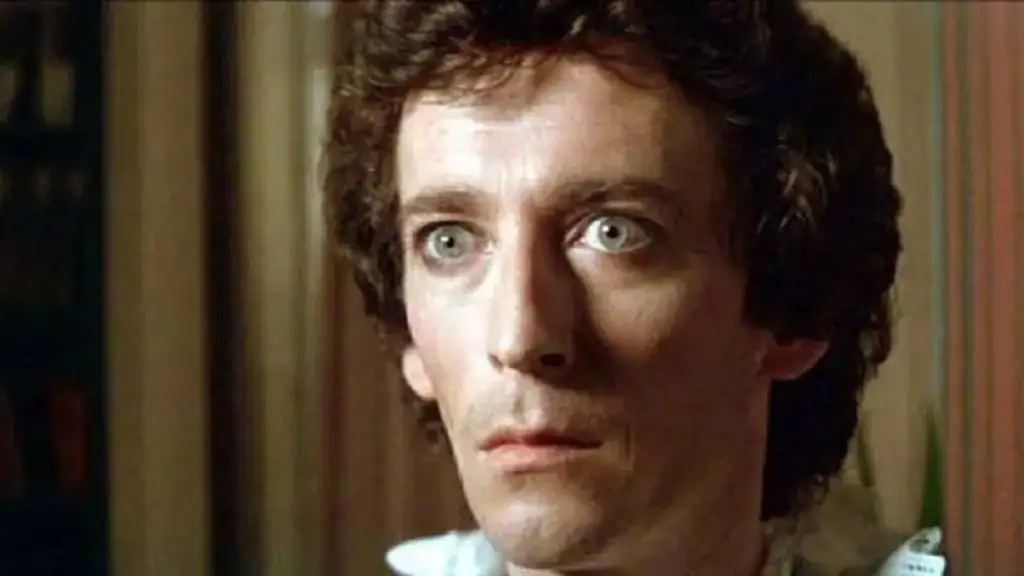
Vastly more accomplished than director Simon Wincer and screenwriter Everett de Roche’s somewhat embarrassing previous film Snapshot (1979), Harlequin won several top prizes at the Sitges International Fantastic Film Festival.
The fantasy thriller continues “Ozploitation”‘s dalliance with supernatural abilities and psychic powers. Which started in the late 70s in films like The Last Wave and Patrick.
However, in its story of a politician coming into contact with a seemingly supernatural force, it has a more similar feel to Richard Donner’s The Omen (1978). But instead of a diabolical child infiltrating a prominent family, it’s an enigmatic, magnetic man named Gregory Wolfe (Robert Powell).
The most obvious inspiration is impossible to miss: Rasputin and his influence over the House of Romanov in early 1900s Russia. For one, many characters share similar names to the players involved in the last years of the Russian royal family.
What’s more, the story follows the general beats of recorded history, starting with the mysterious outsider gaining the family’s trust by miraculously curing a sick child. And, like Rasputin, Wolfe is shown to have an almost hypnotic pull over women while men remain skeptical.
It’s also implied that Wolfe may actually be the historic figure in a new guise: the film’s Spanish title translates to “Beyond Reincarnation“.
While Rasputin’s supposed abilities are debated, Harlequin leaves little doubt that its “faith healer” has supernatural powers. As Wolfe demonstrates some pretty fantastical feats throughout the film.
Although these are initially dismissed as magic tricks, they become increasingly bombastic. However, they are sparingly displayed and conveyed with largely practical effects that still amaze.
The film also makes several colorful changes to Rasputin’s story, presumably to make the film more visually appealing. As well as easier to swallow in a contemporary setting.
Wolfe is first introduced in disguise as a party clown at little Alex’s birthday celebrations. And, once he reveals himself, is far more presentable than the notoriously flithy holy man, rocking some futuristic, glam rock-inspired outfits and make-up.
Perhaps unsurprisingly, producers initially had David Bowie in mind for the role. But they “got cold feet” and cast Powell instead.
Nevertheless, there are serious shades of Labyrinth‘s The Goblin King in both Wolfe’s actions and Powell’s performance. He first appears to the family (out of clown make-up) by seemingly transforming from a bird and making a dramatic entrance through the window of an upstairs balcony. Just as Bowie’s Jareth does in Jim Henson’s later film.
And Powell (who had recently played Jesus) brings Wolfe to life with a nimble gait and theatrical flair that screams Bowie. However, with his piercing gaze and ability to switch effortlessly from playful to fearsome, there’s no doubt that he was a perfect casting choice and the main reason to watch Harlequin.
For much of the film, Wolfe’s intentions are left ambiguous. Leaving both the central characters and the audience unsure as to whether he’s infiltrating the family with malicious or benevolent objectives. Which generates considerable tension, despite the otherwise familiar story.
Score: 7.5/10
Where to Watch Harlequin (1980)
Discover where Harlequin (1980) is available to stream, rent or buy across different platforms and countries.
Alison’s Birthday (1981)
Alison’s Birthday has one fatal flaw: the titular character of this supernatural horror is pretty dumb. And wouldn’t have found herself in peril if she had just listened to a VERY clear warning!
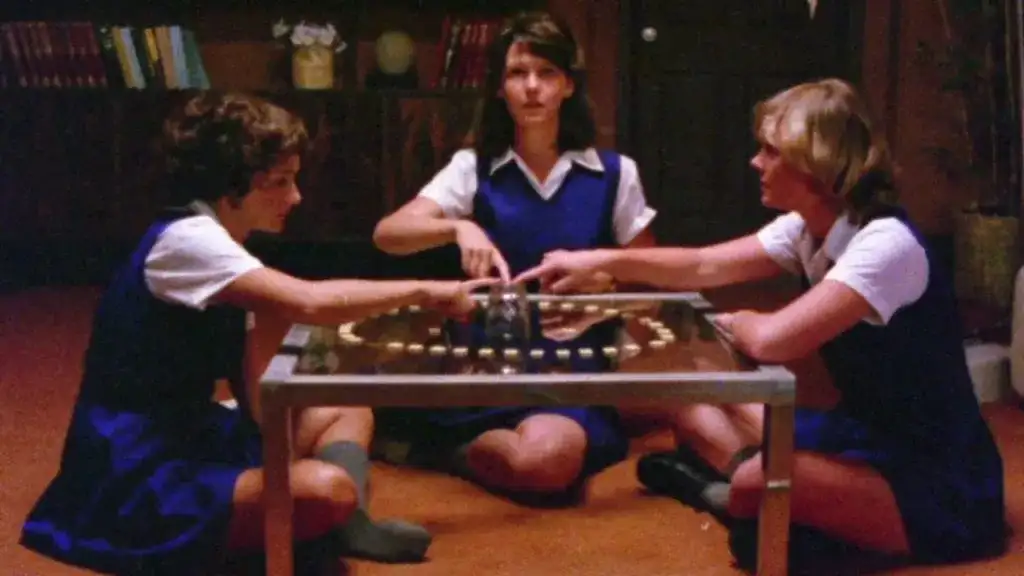
The film begins with three teenage girls (but they don’t look a day under twenty) deciding to try out a homemade ouija board. Although Alison (Mad Max’s Joanne Samuel) has reservations.
After lead coercer Chrissie (Margie McCrae) repeatedly tries in vain to get a spirit to respond, the glass suddenly goes nuts. And spells out a message directed at Alison: she must not return home for her 19th birthday in three years’ time. Then things get crazy.
This sequence is very spooky and quite shocking (despite clearly owing a huge debt to The Exorcist.) And, you would think, scare anyone enough to make sure they got the hell out of dodge before their 19th birthday!
We then pick up three years later, and it seems like Alison got the message: she’s moved out of Sydney and is working in a record store in a small town. But then she gets a call from her beloved Aunt Jenny (Bunny Brooke), imploring her to come home for her birthday.
Alison is reluctant, reasoning that it’s not an important milestone. However, Jenny confides that her Uncle Dean (John Bluthal) is unwell and that it might be the last time they’d be together as a family. So Alison pretty quickly agrees to come home.
So despite the harrowing ordeal and very clear supernatural warning, Alison returns to the suburban house where she grew up. And her loving aunt and uncle warmly welcome her with open arms.
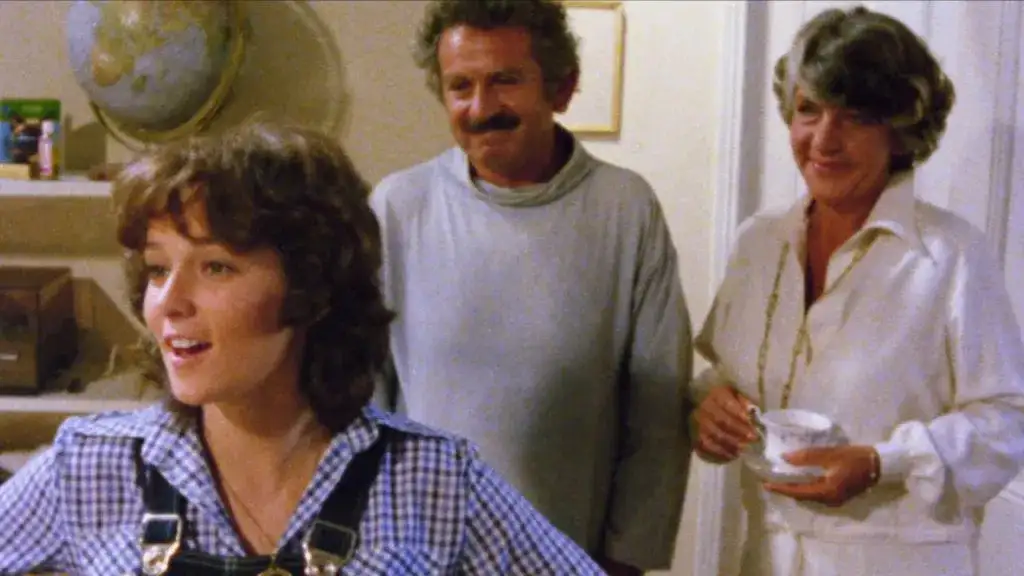
But despite their warm demeanor, Alison begins to suspect something feels wrong. First, she decides to go for a walk down the back of the garden and stumbles upon a massive megalithic structure. Which her uncle explains away as a replica of Stonehenge built by the previous owner, an amateur astronomer.
That she never found it before is quite ludicrous, but her aunt and uncle’s constant warnings about snakes and spiders in the back of the garden seem to have previously put her off. Which I mean…yeah, they’re in Australia!
Next, she’s visited in the night by ‘Granny Thorne’, a wheelchair-bound old woman who her aunt and uncle failed to divulge was confined to a bedroom in the house. And who Alison had never heard of before.
She also begins having vivid dreams of what appear to be pagan rituals. And her aunt seems a bit too eager for her to drink her famous homemade tonics before bed. Soon, she mysteriously falls ill and is pretty much bedbound for the rest of the film.
You can probably guess from a mile off what this is all leading to, but there are some interesting twists and turns in the story. And the acting is solid, particularly Brooke and Bluthal as the cheery and loving aunt and uncle who may be hiding a sinister plot.
They clearly owe their performances a bit of a debt to Ruth Gordon and Sidney Blackmer in Rosemary’s Baby (1968). And the feel of the film is heavily indebted to The Wicker Man (1973).
But as far as copying other films goes, they picked pretty good inspirations. And there’s a last-minute twist that’s quite haunting. Still not over Alison’s stupid decision to return home though!
Score: 6.5/10
Where to Watch Alison's Birthday (1981)
Discover where Alison's Birthday (1981) is available to stream, rent or buy across different platforms and countries.
Road Games (1981)
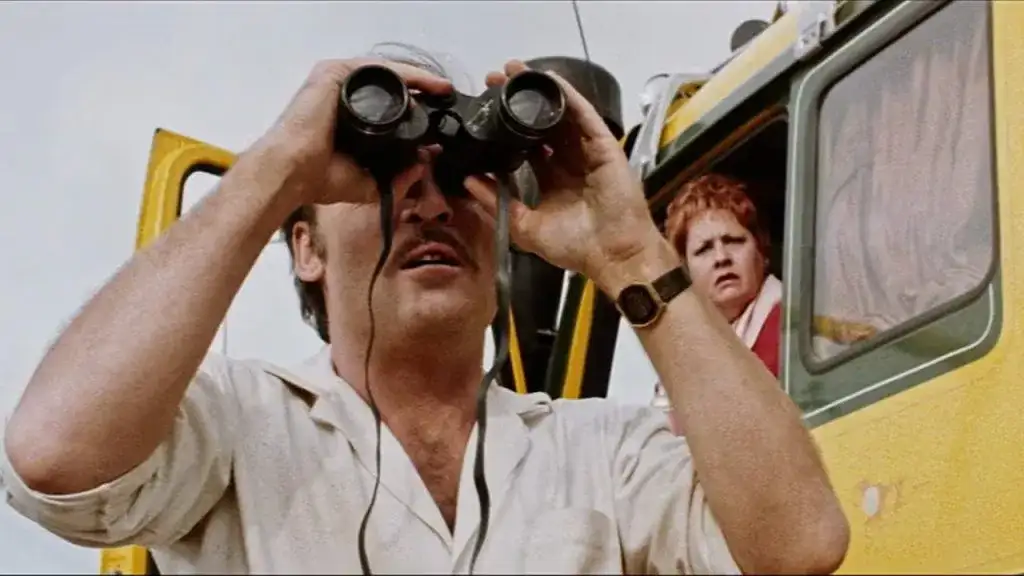
If re-titling Snapshot to The Day After Halloween wasn’t strong enough a sign, Aussie filmmakers were keen to cash in on the success of John Carpenter‘s little indie horror that could. And making a rip-off (albeit in name only) wasn’t their only option.
For his next effort, Patrick director Richard Franklin cast Australian actress Lisa Peers as the female lead. However, the distributor wanted an American, and their choice was simply to import the star of Halloween, Jamie Lee Curtis. Franklin also wanted Sean Connery to star, but he proved too expensive, so instead we get Stacey Keach.
Sidestepping the supernatural elements of Franklin’s previous film, Road Games owes more to Spielberg’s Duel or Hitchcock’s Rear Window than Patrick. Indeed, Franklin had returning collaborator Everett de Roche read the script for the latter when brainstorming ideas for their next film.
It’s basically a road movie with a little serial killer intrigue peppered in, and takes place amid the vast expanse of the Outback. Continuing the emerging sub-genre of Australian “car” movies after Mad Max.
The story concerns an observant American rig driver named Pat Quid (Keach) who is tasked with delivering a truck-load of pig meat from Melbourne to Perth. At first, the journey is uneventful, prompting Pat to chat away to his dingo companion Boswell and people watch in cars going by.
However, he soon begins to suspect that the driver of a dark green van is up to nefarious deeds. Especially after reports of missing women light up his radio.
However, his attempts to surveil this possible killer are hampered by the people he meets along the road. Including a woman who he names “Frita” (Marion Edward), whose husband drove off and left her while she was going to the bathroom.
Despite his policy of no hitchhikers, “Frita” manages to stop him with a barrier made out of pink toilet paper and quickly hops into the cab. And in the few scenes she gets Edwards proves to be a hoot as this brash yet suspicious housewife.
He’s also slowed down by an incompetent driver hauling a boat (you can probably guess what is going to happen to it). And by the police, who think he might be the murderer.
His luck begins to change after he relents on his policy of not picking up hitchhikers and pulls over for an elegantly dressed young woman (Curtis) who he had seen several times along the road. And who is almost equally as obsessed with the serial killer news and eager to help him investigate his hunch.
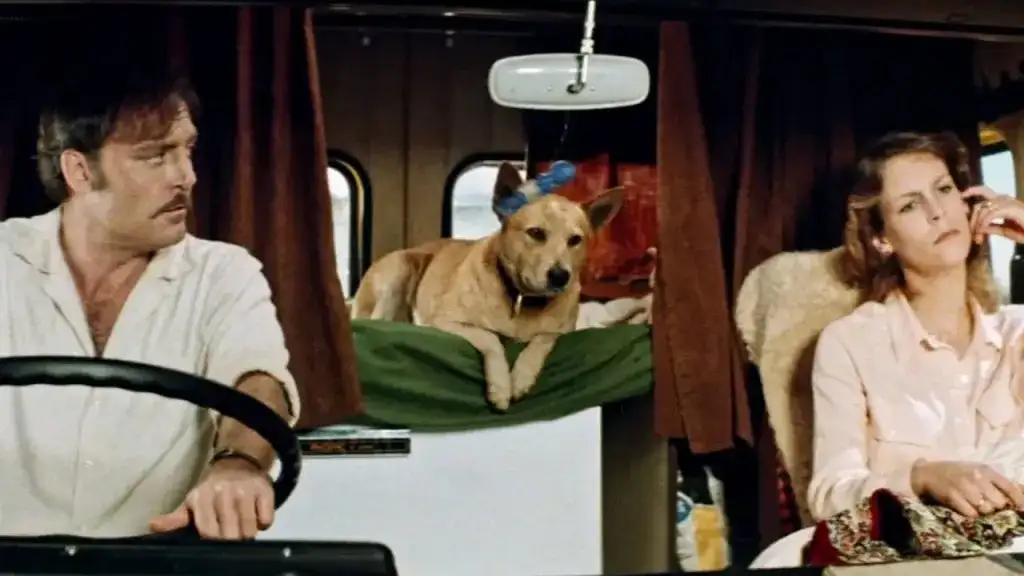
Road Games is actually pretty good fun and has an endearing charm, largely thanks to the characterization of Quid and Keach’s lively performance. He’s somewhat world-weary and disillusioned, but always finds ways to amuse himself and loves quoting classic literature.
It’s quite funny that all the characters are credited by the moniker that Quid gives them, including Curtis’ “Hitch”, even if they get round to stating their real names during the film. It’s an amusing quirk, but also maybe says something about fiercely independent Quid’s desire to keep people at a distance.
Although she only gets around 25 minutes of screentime (something that with hindsight Franklin said he regretted), Curtis brings her usual spunk and charm to the role of “Hitch.” And has pretty great chemistry with Keach, particularly during a fireside heart-to-heart.
Although one contemporary reviewer quipped “Although Road Games was made in Australia, the Outback might as well be the New Jersey Turnpike,” I think that the film actually makes good use of the Australian countryside as a backdrop. There is some stunning cinematography of Outback locales, including of dramatic seaside cliffs and of a half-buried, abandoned desert town.
There’s also some local flavor spiced in at the stops Quid makes along the route. Including a menacing truck stop right out of “The Yabba” in Wake in Fright, complete with hostile men and a disturbing mural showing oppression of Aboriginal figures.
It’s a bit odd that the two main characters never remark on the fact that they are both Americans in a strange land. Although “Hitch”’s status as the daughter of a U.S. diplomat in Canberra somewhat explains her presence (probably added in after Curtis was cast.)
Otherwise, de Roche’s script is solid. The banter between Quid and his passengers is snappy and there are plenty of quirky little details to admire. And the chase scenes are pretty thrilling, helped by some ace editing.
Score: 8/10
Where to Watch Road Games (1981)
Discover where Road Games (1981) is available to stream, rent or buy across different platforms and countries.
Kindred Spirits (1984)
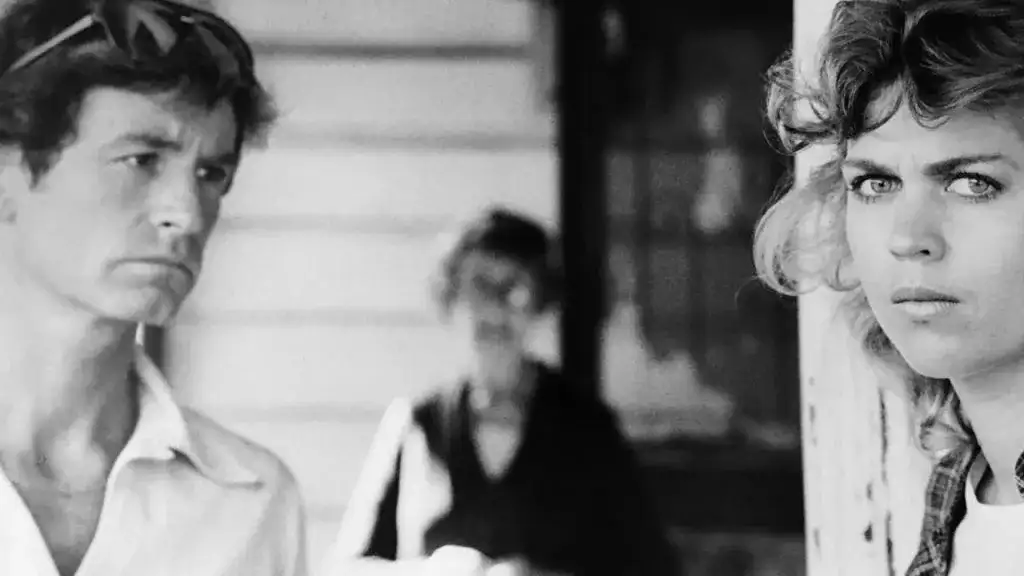
This little-known but impactful TV movie is striking for its juxtaposition of a summertime beach setting with doom-laden psychic visions. And feels heavily influenced by Nicolas Roeg’s classic Don’t Look Now (1973), though it’s really more of a paranormal drama than a horror. But a solid one, nonetheless.
Kindred Spirits also reminded me of another horror classic, Carnival of Souls (1962), in its general mood and several shots and sequences. Particularly those set on a seaside promenade.
The plot follows Julie (Julieanne Newbould) a seemingly carefree young dancer in Sydney who takes a break from rehearsals to travel to the famous Bondi Beach for some sunbathing with her best friend Billy (David Waters).
Side note: I found Billy to be a refreshingly positive and well-rounded depiction of a gay man. After recently sitting through the blatant, face-palm homophobia of Snapsnot.
However, when she goes to take a dip in the water, Julie is suddenly overcome with grey-scale flashes of drowning beachgoers. This leads to an extended vision where she sees a man carried out of the ocean and revived on the sand, only to pass away after locking eyes with her.
This single unsettling event turns Julie into a troubled, worried young woman who can’t get the “fantasy” out of her head. And she starts to see the same man everywhere she goes, gently smiling at her before disappearing into a crowd. Or morphing into a completely different, real person.
After she and Billy do some digging, she realizes that her vision was of a past event (based on a real-life tragedy). And that maybe this ghost has some unfinished business.
However, similar to Donald Sutherland’s character in Don’t Look Now, Julie ultimately misinterprets the intentions of this phantom. And the shocking climax is inspired by another real-life tragedy.
Though whether her eventual fate registers as tragic or not depends on your reading. Which, like the best endings, I think can be interpreted in several ways.
The screenplay for Kindred Spirits is surprisingly robust, and full of red herrings and masterful misdirection. So that you don’t see the surprise twist coming and it catches you completely off guard.
The ending has clearly been restrained somewhat by the limits of a TV movie budget. However, this might actually have worked in the film’s favor, as the rapid-fire editing of surprising visuals is arguably more effective that what a larger budget would have allowed.
The acting is also solid, with Newbould a standout as the increasingly sensitive Julie. Patricia Kennedy (Aunt Gussie in the 1979 version of the recently remade My Brilliant Career) also makes a strong impression in just a couple of scenes.
As of time of writing, Kindred Spirits can be found (although in middling copied-from-a-VHS quality) in its entirety on Youtube!
Score: 7/10
Where to Watch Kindred Spirits (1984)
Discover where Kindred Spirits (1984) is available to stream, rent or buy across different platforms and countries.
Razorback (1984)
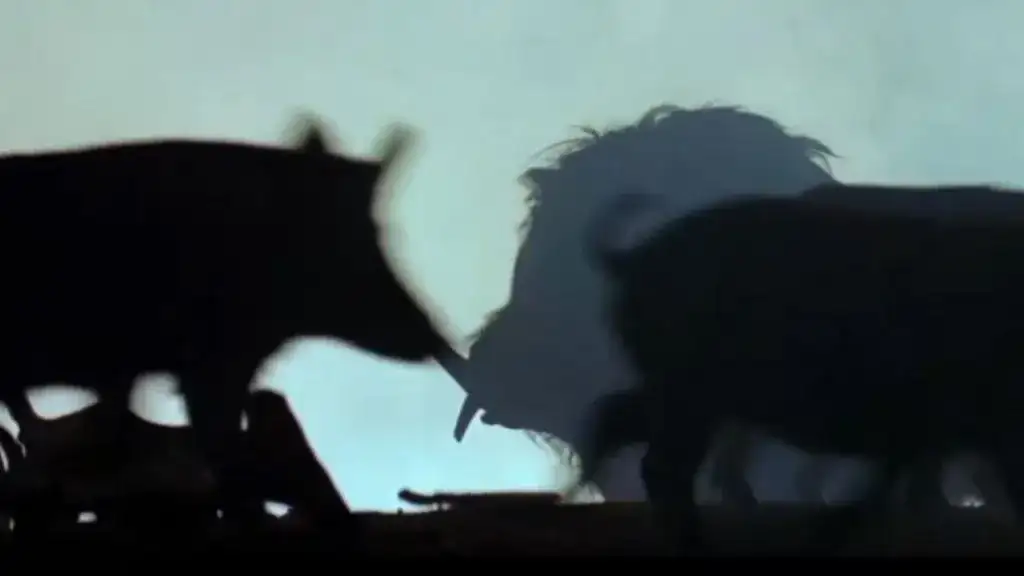
Australia’s first “creature feature”, Razorback is the film directorial debut of Russell Mulcahy. Who started out directing a ton of truly iconic music videos in the 70s and 80s.
Like for ”Video Killed the Radio Star”, “Bette Davis Eyes”, “Total Eclipse of the Heart”, and “Turning Japanese”, among others.
And MANY for Duran Duran, including “Hungry like the Wolf” and “Rio”, two of my favorite ever song promos! Maybe because they are just so damn 80s (and well, I also love Duran Duran!) But they are just so fun, full of gorgeous, inventive shots and snappy editing.
Mulcahy would go on to have a long Hollywood career filled with both cult genre favorites like Highlander (1986) and serious dramas like Prayers for Bobby (2009). And plenty more music videos, as well as episodic TV such as Teen Wolf.
It’s not surprising then that Razorback is probably the most visually accomplished of all the 80s “Ozploitation” films I saw. And uses rapid editing and inventive shot transitions, right out of Mulcahy’s music videos, to keep the action engaging (appropriately, a Duran Duran track also plays during a pivotal scene!).
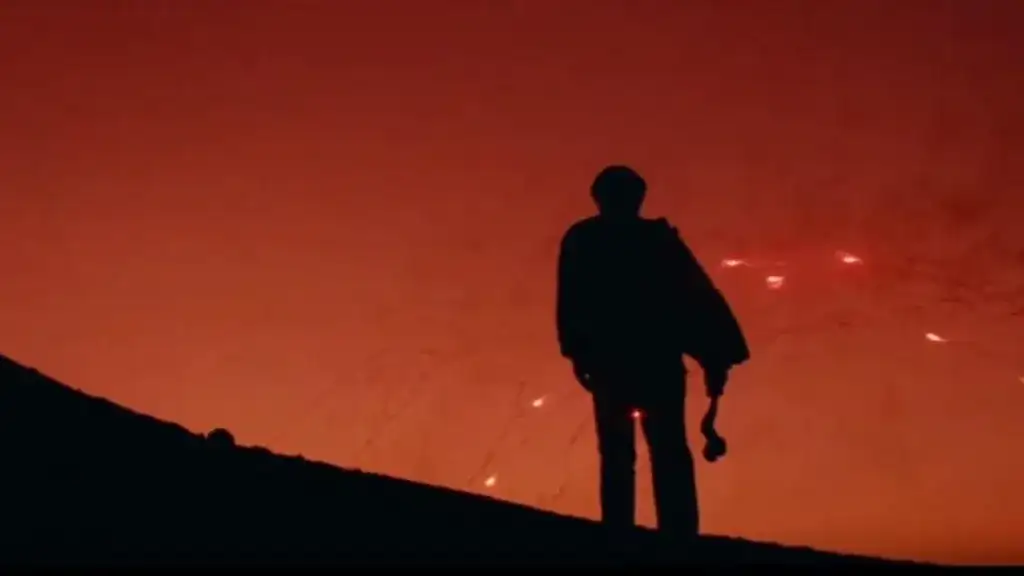
From the very first frame, the director and cinematographer Dean Semler unleash a barrage of startling and gorgeous images; the moon shining through a windmill and the shadow it casts on a desolate farmhouse, a tracking shot of the titular beast itself bulldozing through all of the walls of said house, a close-up on a raven cawing outside a church.
The storytelling is also effective: we see our first hero, noble bushman Jake Cullen (Bill Kerr), go through a traumatic ordeal with the monster right off the bat, followed by public disbelief. And so are really rooting for him to stop the creature and clear his name.
And the next hero we meet, well-intentioned crusading American wildlife reporter Beth Winters (The Plumber’s Judy Morris), is met with hostility when she arrives in the small Outback town of Gumulla. Which in the Aboriginal language means “gut or intestine.”
Appropriate because the main industry is animal slaughter. But she is determined to get her report on kangaroo hunting, despite harassment by some unpleasant bogans.
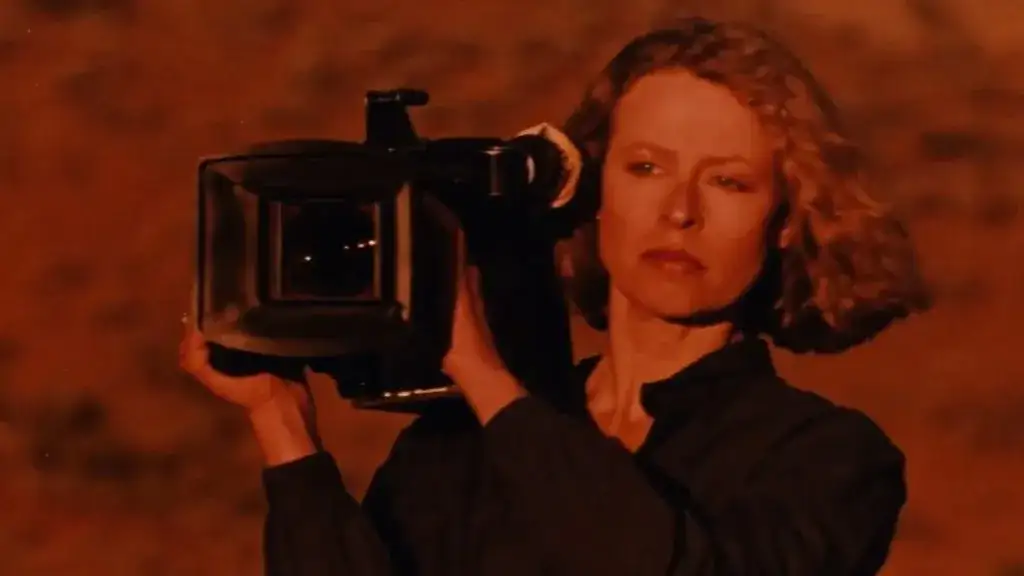
So we are also rooting for her…but well, all I’ll say is…don’t get too attached! But this move from screenwriter Everett de Roche (a repeat offender on this list, who did pretty well for himself during the height of “Ozploitation”) is admittedly effective in further emphasizing the fact that the monster has no moral compass.
We eventually get another hero to root for, and then another. This should have made the film feel disjointed and unfocused, but it works, by taking a page out of Hitchcock’s Psycho playbook.
As Winters is essentially this film’s Marion Crane, and the other characters then come together to defeat Norman Bates (or, in this case, a monstrous boar!) When one hero falls, another rises. It’s actually pretty inspiring, and helps to raise the stakes.
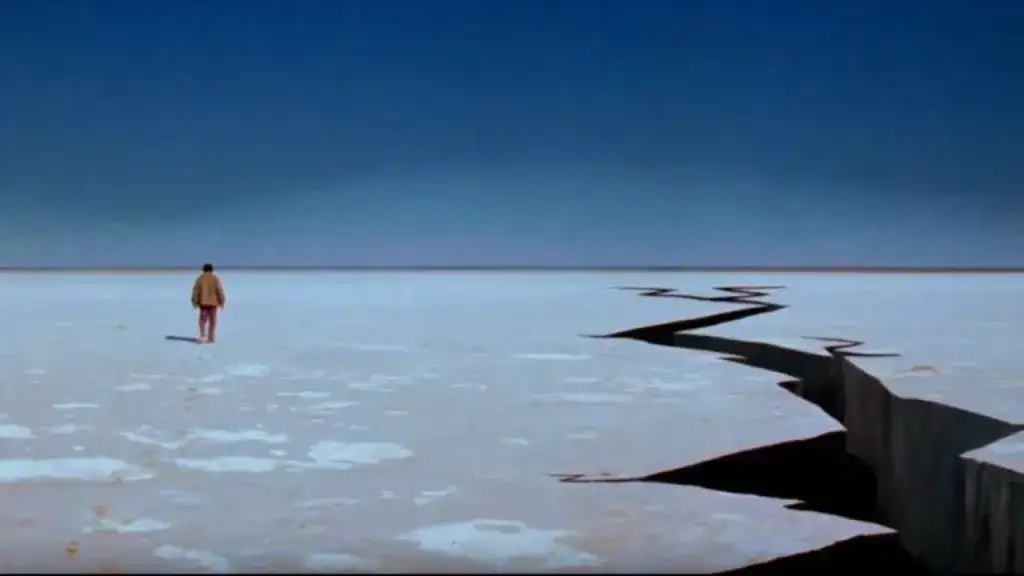
The film also boasts superb lighting, particularly during a trippy hallucination sequence and the nighttime scenes. Which are better lit than most, even today: working directors and cinematographers should seriously take note.
There’s no question that, visually, Razorback is a masterpiece (Semler would later win an Oscar for Dances with Wolves.) And the sound design also deserves a shout out, helping to create a sense of unsettling natural evil to match the best “Ozploitation” thrillers of the 70s, like The Last Wave.
Random observation: I love the film’s Spanish title, which translates to “The Tusks from Hell”!
Score: 8/10
Where to Watch Razorback (1984)
Discover where Razorback (1984) is available to stream, rent or buy across different platforms and countries.
Dishonorable Mention: Strange Behavior (1981)
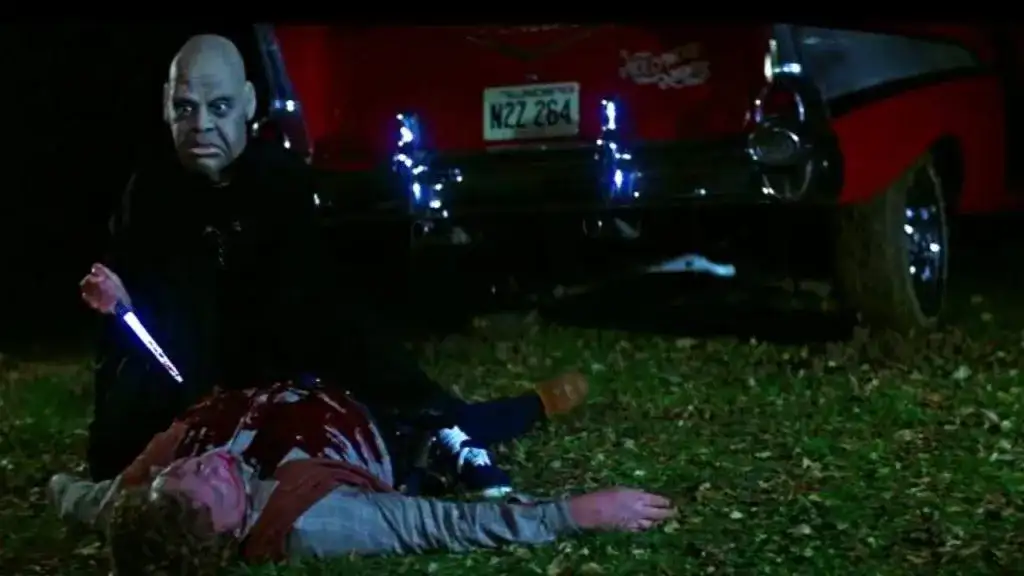
The very definition of a B-movie, Strange Behavior attempts some sort of social commentary about the rise of violence among teens. But it falls flat amidst thin characterization,a ludicrous mad scientist plot, and some truly atrocious dialogue.
Somewhat surprising given it was the screenwriting debut of Bill Condon, who would later go on to win an Oscar for his script for Gods and Monsters (1998) and a nomination for his writing on Chicago (2002). But well, he also directed the last two Twilight films, so go figure.
The most notable thing about this film is that it was the inaugural horror film produced in New Zealand, despite its US setting. As Auckland and its suburbs stood in for small town Illinois, mostly pretty convincingly.
Setting somewhat of a precedent, as later horrors like Peter Jackson’s The Frighteners (1996) and the most recent Evil Dead films would also pass off Kiwi backdrops as the US. But well, it’s still considered “Ozploitation”, largely due to the contributions of Aussie producer Antony I. Ginnane.
However, the producers also opted to import a largely American cast. Including One Flew Over the Cuckoo’s Nest Oscar-winner Louise Fletcher (in an utterly thankless side role, and she looks a little embarrassed to be there.)
And Micheal Murphy as the lead, no-nonsense sheriff John Brady. Whose acting contemporary reviews singled out for praise, which I cannot get my head around, because Murphy is BAD in this film.
The veteran actor has given a lot of solid performances across his storied career, both before and after this movie, including in several Robert Altman classics, Peter Weir’s The Year of Living Dangerously (1982), and Batman Returns (1992). But here he comes across as incredibly wooden, delivering most of his lines in a sort of angry whisper.
He’s done no favors by the amateur direction, as director Michael Laughlin seems more interested in the back of his head than capturing his (limited) expressions. This includes a seemingly never-ending shot where Murphy and Fletcher attempt to open a crypt in a mausoleum, which will have you checking your watch.
At least the actors playing the villains fare better. Although they have to spout some of the most ridiculous exposition in the film, Arthur Dignam and Fiona Lewis seem to know exactly what kind of film they’re in and relish their mad scientist roles.
The film also references its 50s B-movie inspirations by having one of the killers wear a mask of the likeness of actor Tor Johnson, best known for his collaborations with the infamous Ed Wood. And it’s actually pretty unsettling, particularly during a sequence at a swimming pool, probably the film’s only genuinely scary scene.
Ultimately, the biggest source of fun comes from spotting which of the performers are native Kiwi actors based on their wavering accents. Which says a lot about the entertainment value of the rest of Strange Behavior.
Score: 4/10
Let you know what you think of my picks on Instagram! And stay tuned for my next list, which covers “Ozploitation” horror/thrillers in the second half of the 80s!
Where to Watch Dishonorable Mention: Strange Behavior (1981)
Discover where Dishonorable Mention: Strange Behavior (1981) is available to stream, rent or buy across different platforms and countries.