
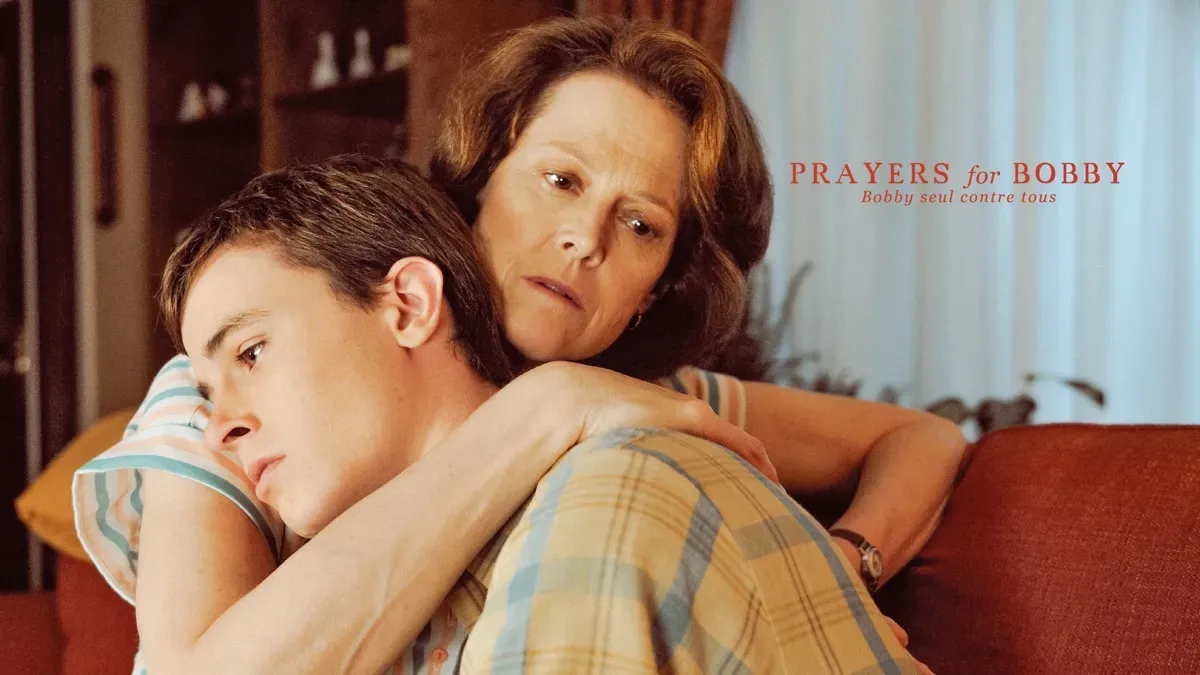
Where to Watch Prayers for Bobby
Discover where Prayers for Bobby is available to stream, rent or buy across different platforms and countries.
Why I took it off the list:
I was considering writing a new list about movie romances, but a variety of factors made me realize that this was an essential and timely film to review for my next post.
Firstly, it’s Mental Health Awareness Month. As I’m finally starting to manage serious problems with anxiety and depression, I wanted to spotlight a film that depicts an often misunderstood illness that an estimated 280 million people worldwide struggle with.
Secondly, the International Day Against Homophobia, Biphobia and Transphobia was observed on May 17th. Something that is still necessary as anti-LGBTQ+ hate crimes are still sadly a common occurrence around the world.
Lastly, news broke that the UK government has pledged to ban the incredibly damaging practice of conversion therapy. However, this is the 5th time in 8 years that it has done so and it has not yet come into law.
And Prayers for Bobby is a film that touches on all of these subjects. So I decided now was the time to revisit it.
I first saw it years ago and it hit incredibly close to home for me. I know all too well the struggles that the title character goes through in the film.
Seeing Bobby’s anguish, as well as developments later in the film, left me in floods of tears. Honestly, I still get teary just thinking about a couple of scenes.
Review of Prayers for Bobby (2009)
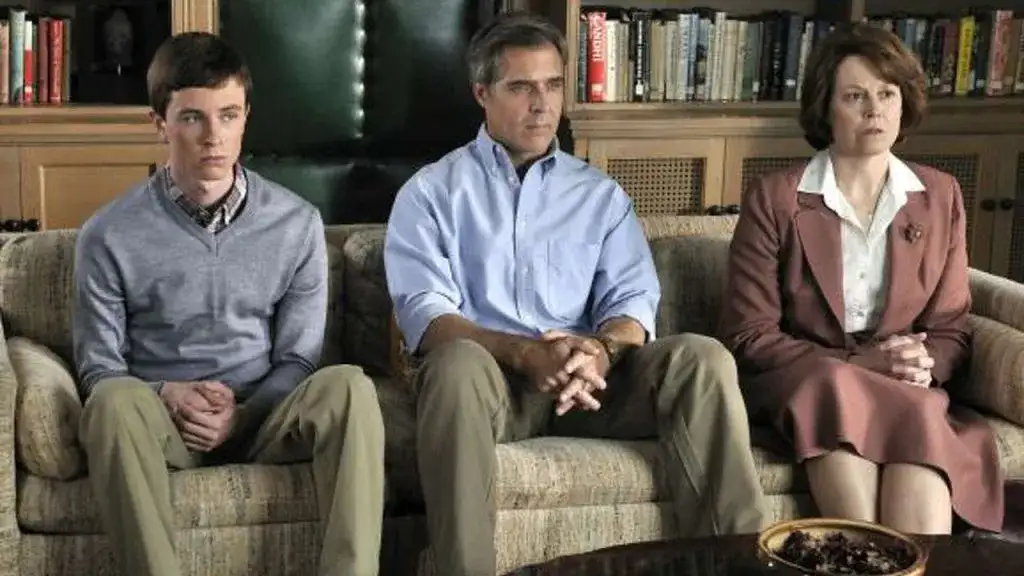
Based on an incredibly moving true story, Prayers for Bobby follows the Griffith family through religious turmoil that leads to a devastating loss and then to an unlikely and inspiring transformation.
Matriarch Mary (Sigourney Weaver) is a devout evangelical Christian who instills a strong belief in the family that, if they just resist the temptation to sin by Satan, they’ll all be reunited in the afterlife after they die. She even gives random pop quizzes to see which one of her four children can guess Bible verses first.
But she is no raging fanatic. She deeply loves her husband and children, and wants to see them happy. And she has an especially strong bond with her sensitive son Bobby (Ryan Kelly).
In a heartwarming scene, they watch a classic Hitchcock movie together. Because, as she puts it: “If it’s not John Wayne, your dad’s not interested.” (I can heavily relate!) And she is amazed by his deep knowledge of cinema.
On the surface, the Griffiths seem to be the picture-perfect All-American family. But, unbeknownst to his parents and siblings, Bobby is in inner turmoil: he’s coming to the realization that he’s gay.
So he’s understandably troubled when, during his grandmother’s birthday party, his brother Ed (Austin Nichols) grabs a purse and does a stereotypical impression of a homosexual. And Mary retorts, “Stop that. It’s disgusting”.
Oh, and his granny declares that “If you ask me, queers should be lined up and shot.” Something I personally heard a variation of from a family member while a sexually confused teen, and which profoundly disturbed me. So I can fully empathize with Bobby’s ensuing anguish.
Also at granny’s party, the cantankerous old woman rejects one of the gifts, a journal, which ends up in Bobby’s hands. This is a crucial development, as it allows us to follow, through voice-over, the young man’s inner thoughts. Which are lifted directly from the real Bobby’s diary.
And his feelings of unworthiness and fear of being damned are heartbreaking to hear. Bobby becomes increasingly depressed, and, in a harrowing scene, decides to take his own life.
However, his brother arrives home before he can go through with it, and Bobby breaks down and confides in Ed that he may be gay. And he swears Ed to secrecy.
But the older boy later decides that his parents need to know. While they are out driving together, Ed breaks his promise and tells his mother, “He thinks he might be homosexual.” Mary’s first reaction is outright denial. She replies with a firm certainty: “He’s not”.
Once Ed insists that Bobby is “in really bad shape”, Mary starts to worry a little. But she then declares: “There is no doubt in my mind that God can handle this. He’ll heal Bobby.”
And so Mary embarks on a quest to ‘cure’ her son, as she “will not risk her family not being together in the next life”. She pores over her Bible for answers, and tapes what she sees as relevant verses to the bathroom mirror and all over Bobby’s room.
She then consults David Reuben’s 1969 book Everything You Always Wanted to Know About Sex, but Were Afraid to Ask. Which stated “If a homosexual who wants to renounce homosexuality finds a psychiatrist who knows how to cure homosexuality, he has every chance of becoming a happy, well-adjusted heterosexual.”
Something most logical human beings now know for certain, largely thanks to Netflix doc Pray Away, isn’t true. And which Rubens himself would also take back in his 1999 revision of the book.
But these were different times, and Mary is relieved to read this. She soon books Bobby in for sessions with a questionable psychiatrist, who couldn’t be more colder and unsympathetic if she tried.
But, thankfully, Bobby starts to see some positive representation of queer culture and rebels against his mother’s interference in his life. And after an especially heated argument, she renounces him as her son.
Bobby moves to Portland to live with a cousin who’s far more liberally minded, and even gets a boyfriend. But after seeing his guy leaving a bar with another man, and with his mother’s words echoing in his head, he takes his own life.
Weaver and Kelley’s Powerful Performances Elevate the Film
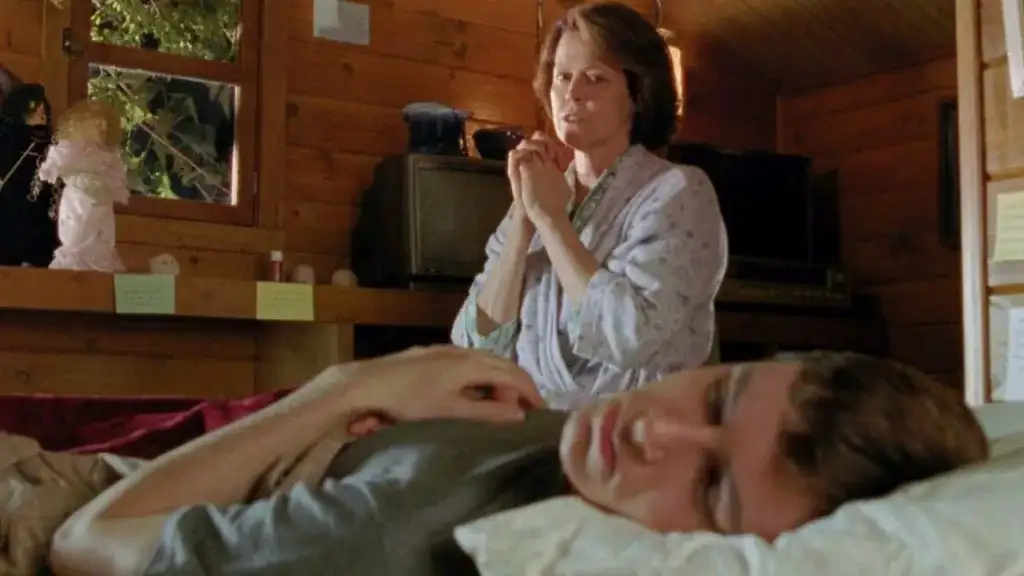
In the first half of the film, the focus is squarely on Bobby, and Kelley perfectly inhabits the role.
The actor, so good a few years earlier in underrated teen thriller Mean Creek (2004), sketches out a subtle portrait of a thoughtful and caring young man who begins to feel genuine joy once he begins to explore his sexuality.
And then Kelley palpably transmits the utter defeat that leads Bobby to tragically take his own life.
After the depiction of this tragedy, and, as if there would ever be any doubt, Weaver is the MVP of the rest of the runtime.
When the call no parent wants to receive comes in, Mary is at work in her warehouse job and her husband Robert (Henry Czerny) has to break the news to her through a wire-mesh locked gate. And it’s absolutely heart-wrenching to see a distraught Weaver claw at the metal to get out as she screams, ‘Help me! My son is dead!”
She then carefully and precisely depicts the emotional wringer that Mary goes through in the aftermath, which leads the character to seek out the pastor of a queer-friendly church for answers. At first she is combative, asking, “What do you tell people that come here? Gay people. That homosexuality is OK?”
But after a couple of fiery debates with the pastor, Mary is persuaded to attend a meeting of PFLAG (Parents, Families and Friends of Lesbians and Gays) and her views slowly start to change.
This leads to two incredible monologues which Weaver pours her soul into. I dare you not to cry during the second speech, which is beyond powerful. And probably secured Weaver’s well-deserved Emmy and Golden Globe nominations.
The ever-dependable Czerny, despite limited screen time, also gets a well-rounded character to work with, depicting Robert as a more level-headed foil to Mary’s extremity.
Meanwhile, Kelley’s Mean Creek co-star, the incredibly emotive Carly Schroeder, also makes a strong impression as his sibling Joy. They have a sweet chemistry as brother and sister, likely the result of having worked together in the past.
Nicols (whose roles before this included a guest spot as a teen hook-up of Brenda’s in Six Feet Under!), also gets to paint Ed as an uncommonly gentle jock. Although he goes a bit overboard in the scene where he learns of Bobby’s death.
Speaking of going overboard, one of the few criticisms I’ll give the film is that the music is incredibly overbearing at times when it really isn’t necessary, which could be a put-off for some.
What’s more, Russel Mulcahy was an odd choice for director. Although he’s openly gay, he was best known at the time for his genre work, particularly for directing cult favorite Highlander (1986). And here he employs some unnecessary camera and editing techniques to underscore the characters’ distress.
Also, during passages where Bobby is reading his diary, Mulcahy splices in bizarre and very literal imagery of the boy tangled in telephone cables and wrapped up in barbed wire. And it simply doesn’t mesh well with the tone of the rest of the film.
An Essential Watch, Especially for Parents of Queer Children
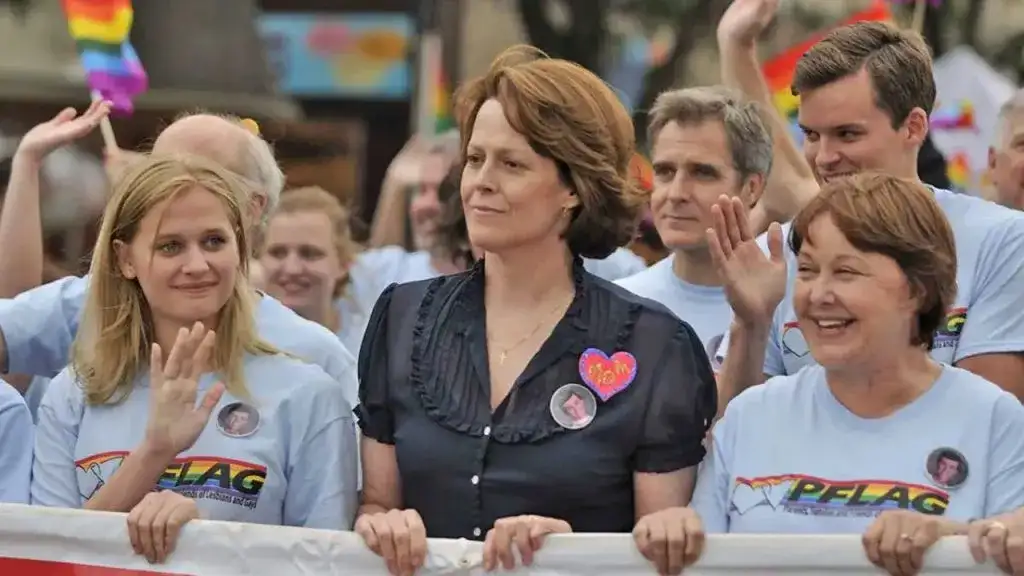
Luckily, the script for Prayers for Bobby is incredibly solid and would stand up to any Oscar-nominated screenplay.
It really shows that scribe Katie Ford has thoroughly researched this story and explored it from all angles. This is best exemplified by the scenes in which Mary debates scripture with the pastor.
In these sequences, many of the common interpetations of homosexuality in the Bible, which I heard often as a child and teen, are thankfully debunked. And it’s made clear that being gay does not mean you have to sever belief in God.
I grew up with a fervently religious mother who told me that homosexuals were “dirty and unnatural”. Who, after watching Billy Elliot, declared that it was a sad story becuase the character was likely gay and “wouldn’t get into heaven”.
Who, after I came out, bombarded me with abusive calls telling me “I was no son of hers”, that I had sold my soul to the Devil, and that I was going to hell. All of which left me incredibly distressed and, regrettably, considering suicide. Luckily, I had a support system of friends who talked me down and got me into therapy.
As other films like Boy Erased (2018) have shown, there are plenty of other queer people who face the same shaming from thier parents. Who consequently have battles with mental health and/or decided that suicide was the only solution to their distress.
And whose parents, like Mary, later regretted the role they played.
In the film, the pastor tells Mary that it was Bobby himself who chose to take his own life. He was simply, tragically, not in his right mind.
If he had been, he perhaps could have sought out the help avaialble and lived a full and joyous life. However, as Mary herself accepted, her rejection of him was, without any doubt, a factor in leading to his suicide.
Prayers for Bobby ends with a title card showing a picture of the real-life Mary Griffith and informs us that “Her tireless work protecting the rights of gay and lesbian youth has establised her a major force in the fight for human rights.”
And then a quote from Mary that is perhaps the most important takeaway from this film: “Before you echo Amen in your home or place of worship, think and remember. A child is listening.”
Final Score: 8/10
Worth Watching?
Yes, although it’s mostly set in the 80s, Prayers for Bobby sadly remains relevant to this day and is an essential watch for anyone who sympathizes with gay rights.
Although horrifically tragic in parts, it’s also a deeply moving and triumphantly hopeful story about people’s ability to change.
The film’s main focus is on Mary’s battle between her unshakable beliefs and her love for her son, and her incredible transformation into a gay rights activist. But it’s also, in the scenes with the psychiatrist and the PFLAG meetings, a damning indictment of conversion therapy.
A practice that, because it is so harmful to kids and teens, needs to be abolished worldwide. But, sadly, this isn’t likely to happen anytime soon.
There seems to be hope for the UK, at least. If you agree, sign the petition to ban conversion therapy in England and Wales.
The petition for Scotland, which received over 5,800 responses, is currently under consideration by the Scottish Parliament.