

Where to Watch Best “Ozploitation” Films: 80s Horror/Thrillers – Part 2
Discover where Best “Ozploitation” Films: 80s Horror/Thrillers – Part 2 is available to stream, rent or buy across different platforms and countries.
We're sorry, no streams available for Best “Ozploitation” Films: 80s Horror/Thrillers – Part 2.
Why I made the list:
After exploring the best “Ozploitation horror and thriller films from the 70s and the first half of the 80s, I decided to finish things up with the 80s output.
And it’s something of a goodbye to “Ozploitation” horror for now. As the genre would mostly lie dormant until a new wave of low-budget Aussie horror would emerge in the 2000s (I will later take a look at the best of these!)
However, as 80s “Ozploitation” horror was on the wane, scfi-fi and fantasy was on the rise. So I will be taking a look at some of those movies soon!
All the films I saw were reasonably solid this time around (although some more than others.) So I didn’t feel the need for a “Dishonorable Mention” in this “Ozploitation” list!
So, let’s dig in!
Fortress (1985)
From personal experience, I can say that managing a class of children is challenging enough on its own. So can I only imagine what it would be like having to do so under life-or-death circumstances.
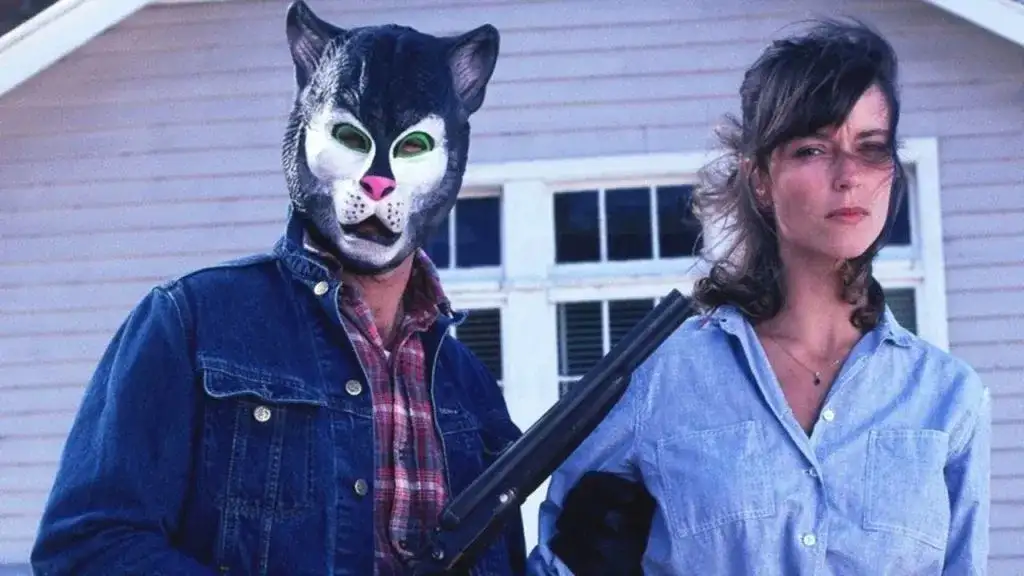
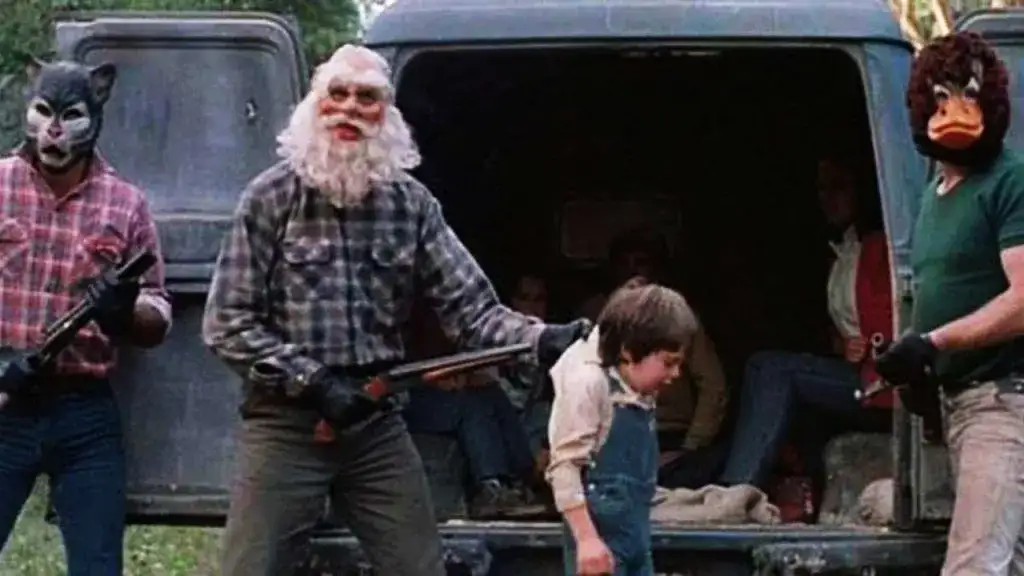
This is the unenviable situation that teacher Sally Jones (Rachel Ward) finds herself in when armed kidnappers in creepy masks storm her rural, one-classroom schoolhouse and abduct her. Along with the nine mixed-aged kids under her charge, intending to hold them all for ransom.
Based on the novel of the same name, which was in turn inspired by the real-life 1972 Faraday School Kidnapping incident, Fortress is an exemplary survival thriller.
The film benefits from a tight script from “Ozploitation” maestro Everett de Roche. He successfully manages to balance escalating stakes with rich characterization, and this might be his strongest screenplay of the decade.
I won’t say much about the plot progression of Fortress. As it contains many surprising twists and turns which you should discover for yourself.
But after the kidnapping, it turns into a sort of adventure film with strong Lord of the Flies vibes. And pivots around the strengthening bond between the teacher and her students.
Ward is fantastic as the quick-thinking yet compassionate Ms. Jones, who turns out to be exactly the kind of teacher you would want under such harrowing circumstances. And she gets a pretty satisfying arc throughout the film, going from somewhat squeamish and pacifistic to a resolute fighter once she begins to lose her cool.
And the filmmakers really lucked out when casting the children. All of the nine kids give strong, believable performances as vividly defined individuals. Including Rebecca Rigg (Jerry Maguire) as insecure older girl Narelle and a very young Asher Keddie (The Devil Game) as the precocious Sue.
The meaning of the title doesn’t become clear until the third act of Fortress, which builds a certain sense of anticipation. And the reveal doesn’t disappoint, hinging around a spectacular, hand-built set that’s the scene of the film’s thrilling and satisfying climax.
And the (award-winning) cinematography is beautiful, making good use of the rugged Grampians mountain range and spectacular Buchan Caves filming locations. There’s also some excellent underwater photography in one of the film’s standout, nail-biting sequences.
Score: 8/10
Where to Watch Fortress (1985)
Discover where Fortress (1985) is available to stream, rent or buy across different platforms and countries.
Fair Game (1986)

This action/thriller is definitely the most exploitative of all the “Ozploitation” films I’ve seen so far. Fair Game sees an improbably glamour model-level beauty terrorized by three crazed kangaroo hunters in a souped-up vehicle on her remote wildlife sanctuary in the Australian Outback.
And the film revels in exposing her breasts in a way that its villainous goons would approve of. Nevertheless, the script does make an attempt to give actress Cassandra Delaney something of a character to work with.
During the first act she is credible as a strong-willed and fierce woman defending her land and ideals. There are some serious shades of The Terminator’s Sarah Connor in there: Delaney’s features evoke a young Linda Hamilton, and she has a similar, very 80s, hairstyle in the early going.
But as the hunters’ provocations escalate and after she is subjected to a humiliating ordeal, the filmmakers turn Jessica into a typical damsel in distress. And she spends the second act helplessly running around the bush, a far cry from the cool-headed and resourceful leading lady developed in Fortress just a year earlier.
Admittedly, after she finally starts to get a bit cunning and properly takes a stand, her climatic showdown with the goons is pretty satisfying. When she becomes more calculating in her tactics and is literally able to defeat “The Beast”, the monstrous truck that has terrorized her from the first scene.
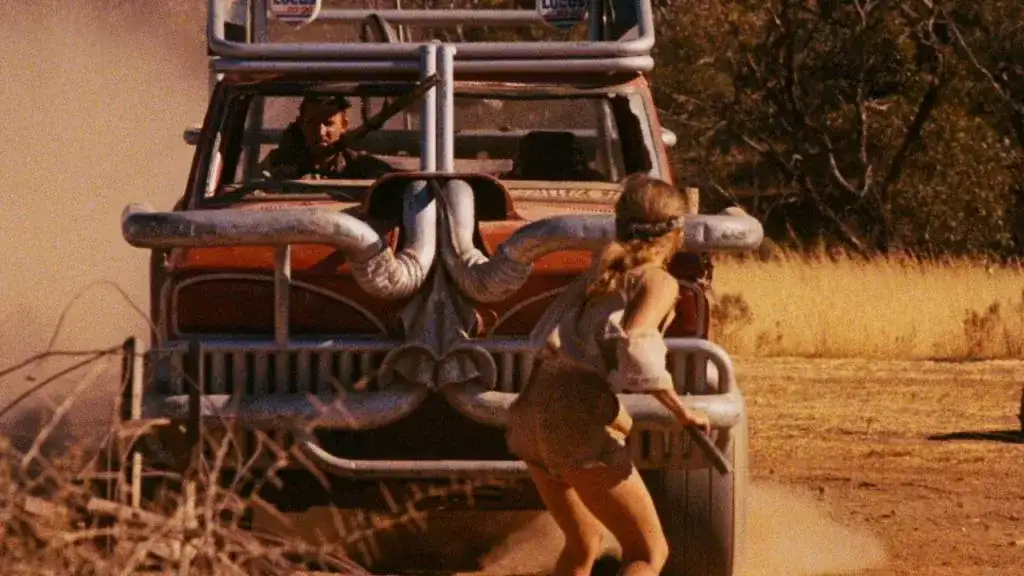
After watching it, it’s no surprise to learn that Quentin Tarantino is a huge fan of Fair Game. The film’s plot is essentially his Death Proof (2007) in Aussie clothing and features numerous car chases and even a scene of a woman strapped to the front of a moving vehicle. And he’s called the movie “an absolute classic.”
I personally wouldn’t go that far. Like Death Proof, Fair Game is certainly entertaining as a pulpy action thriller, but it doesn’t have much going on under the surface.
It lacks the depth of its two clear inspirations, Wake in Fright and the Mad Max films. Even if it has enough good taste not to copy the distressing images of animal slaughter in the former (there is plenty of it, but it’s implied off-screen).
However, the director has said that his intention was always to make a “B-grade video suspense thriller” and that he was dismayed that “people were taking it seriously.” And there’s no doubt that as “a comic book study of violence,” it succeeds.
Fair Game also earns points in its somewhat nuanced depiction of one of the hunters. While the two lackeys are exaggerated bogan stereotypes that could have wandered off the set of Mad Max, leader Sunny (Peter Ford) is intriguingly painted as more complex.
In Sunny and Jessica’s first in-person encounter, he comes across as intelligent, respectful, and even charming. But once he’s behind the wheel of “The Beast”, it’s almost like he becomes possessed. And sees her as nothing more than prey to be hunted.
There are also a couple of inventive shots in the film, including a dolly zoom to empathize Jessica’s terror. And some creative sound design which uses real animal noises to accompany “The Beast”’s mechanical roars.
However, the latter is severely undercut by a loud and intrusive musical score that does Fair Game no favors, full of screeching electric guitars that seem divorced from the action on screen. And the song that plays over the closing credits is just plain cheesy.
Score: 6.5/10
Where to Watch Fair Game (1986)
Discover where Fair Game (1986) is available to stream, rent or buy across different platforms and countries.
Dead End Drive-In (1986)
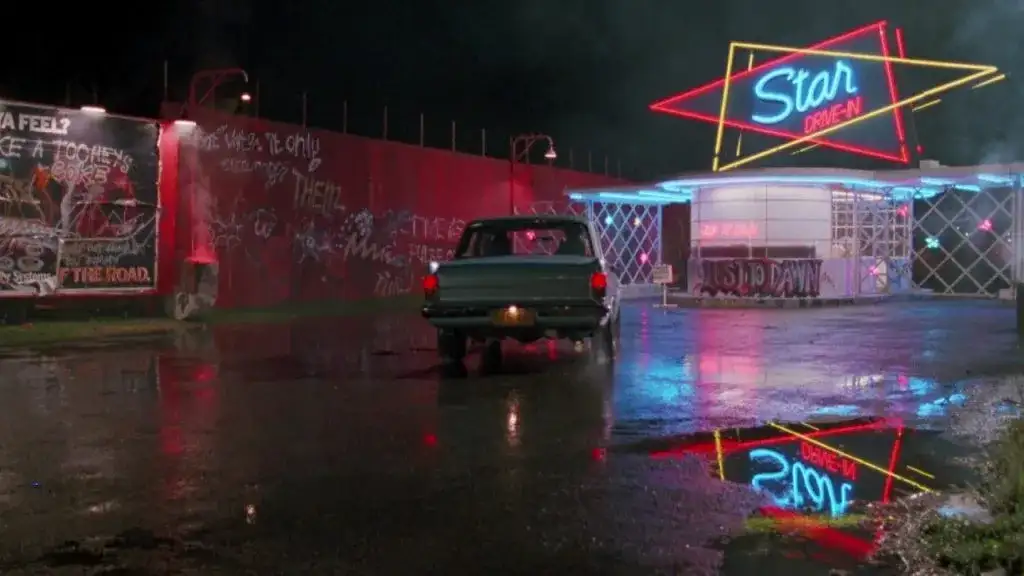
The 80s “Ozploitation” thriller I was most looking forward to seeing, since I’ve had it on my watchlist for years. And the striking poster stuck in my head for just as long.
Somewhat disappointingly, the one-sheet of a The Crow-like Goth with a menacing smile promised a darker and more twisted film than the garish sci-fi actioner I actually got. As far as I can tell, the character doesn’t even appear in the movie!
Instead, we get the bland everyman “Crabs” (Ned Manning, incredibly wooden) as a protagonist. Perhaps the most notable thing about him is his nickname, the explanation for which also eventually proves to be underwhelming.
His girlfriend Carmen (Natalie McCurry) proves to be a more intriguing character. Her punk attire and initially rebellious attitude directly contradict her later actions, best illustrating one of the main themes the movie is trying to convey.
The dystopian world of the film (which boasts impressive retro-futuristic yet decayed production design) is nicely set up in just a few, computer-typed title cards. Which detail events in the then-near future of 1988-1990.
Putting aside a mention of an improbable 1989 “great white massacre” in South Africa (though this does explain a development later in the film), these predictions of economic collapse, widespread unemployment, food shortages, and riots remain credible.
The last title card ominously announces that as a result of these events, the “Government invokes emergency powers.” However, this is not apparent during the first act of the film, which shows that Australia has become a Mad Max-esque hellhole.
Violent hoodlums terrorize and rule the roads. And police are shown as helpless and inefficient.
And, recalling the warped society of The Cars that Ate Paris (1974), tow-truck drivers have the most lucrative businesses. Even competing to see who can first claim the vehicles wrecked in the (many) accidents caused by the so-called “carboys”.

“Crabs” is first introduced as he tries to work out in order to become strong enough to join his tow-truck driver brother on his dangerous missions. Despite his family’s insistence that he will always be a “small man”.
One day, he breaks a rule to take Natalie out for a spin in his brother’s prized, off-limits vintage Chevy. And they decide to head to a remote drive-in movie theater.
However, unbeknownst to them, it’s actually a trap to capture “carboys.” The gates lock behind them and they find themselves surrounded by electrocuted barbed wire fences: the drive-in turns out to be an internment camp for “undesiables” until the government can decide what to do with them.
The police are shown importing drugs to placate the “carboys”. And the inmates are fed on a diet of junk food and “bad” exploitation movies (which, suitably, includes Snapshot!)
Unlike Carmen, “Crabs”, who throughout the film is shown to be something of a health-freak, is not satisfied with this new status-quo and seeks a way to escape. Which mostly involves sucking up to the jolly projectionist/camp overseer Thompson (Peter Whitford, easily giving the strongest performance as the most nuanced character).
Dead End Drive-in is based on “Crabs”, a short story by novelist Peter Carey. Whose work was also adapted into the wonderful Bliss (1985), as well as the Ralph Fiennes and Cate Blanchett-starrer Oscar and Lucinda (1997). And the adaptation is pretty faithful, as far as I can tell.
However, the film heightens some of the story’s themes of rebellion amidst oppression, pressure to conform, and the machinations of an inept government (the central concept is quite ludicious, but perhaps that’s the point.)
And, as this primarily turns out to be an action film rather than the psychological thriller I thought I was getting, adds in plenty of explosions and vehicle-based stunts. Which admittedly are pretty impressive, even breaking a record at the time.
The VERY 80s score and cheesy songs also carry over from Fair Game, although they are less obnoxious than in that film. And, overall, I’d rate Dead End Drive-in a bit higher as it at least makes an attempt to develop its themes and social commentary. But well, the bad acting puts it on even footing.
Score: 6.5/10
Where to Watch Dead End Drive-In (1986)
Discover where Dead End Drive-In (1986) is available to stream, rent or buy across different platforms and countries.
Initiation (1987)
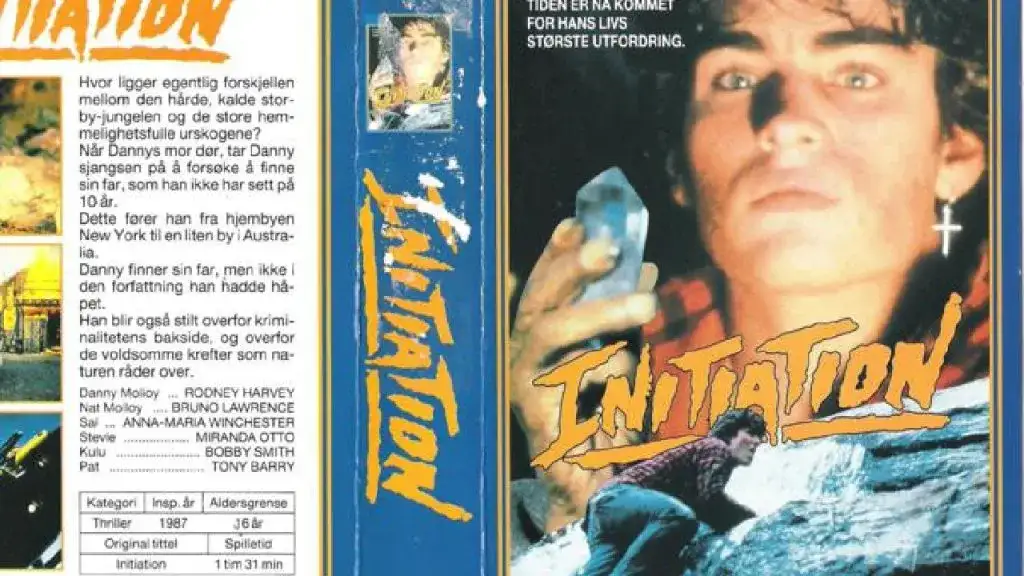
My main reason for checking out Initiation was the presence of a very young Miranda Otto in a supporting role. She would also appear in another “Ozploitation” film the following year, supernatural horror The 13th Floor. But by all accounts that is godawful, so I decided to stick to this!
There’s no getting around it: Initiation is Walkabout-lite in almost every way and comes across as like a YA version of that film. The premise is very similar (just replace English schoolchildren with a single American teenager.) There’s also some Aboriginal mysticism at play, and the modern world is shown to be just as brutal as the wilderness.
But where that earlier classic got to the Outback pretty quickly, Initiation takes almost a full hour (out of only 90 minutes) to strand its protagonist, Danny (Rodney Harvey) in the bush. And turn into the survival thriller it was sold as.
Even then, Danny has it easy compared to the Walkabout kids and gets out of his dilemma pretty quickly. Thanks to some lazy uses of the Magical Native and Hollywood Dreamtime tropes that are a far cry from The Last Wave’s thoughtful exploration of Aboriginal beliefs.
Before that, it’s essentially a family drama about a Brooklyn teen reuniting with his estranged bushman father, with some crime thriller intrigue sprinkled in. As the older man’s crop-dusting business is going down the drain. And he has agreed to use his plane to smuggle weed across the country for some shady Italian mafiosos.

Puzzingly, Initiation heavily uses voice-over narration to express Danny’s thoughts about arriving in this strange land during the first act. Which I assumed was introduced so as to carry over when he gets stranded in the bush.
However, the film completely abandons this tool once he starts to integrate into his father’s new family. Which, I dunno, might have been intentional so as to show he’s getting out of his head and engaging with his surroundings? Though I have my doubts.
Once it eventually gets going, Initiation is a serviceable enough thriller with a couple of memorable sequences. Particularly one in a cave where Danny ingests some psychedelic mushrooms and has some trippy visions (including of a very cool animated owl!)
But there is not nearly enough of this novelty in the film. And there is no real resolution to much of the conflict set up in the first part of the film.
Still, the acting is much better than in Dead End Drive-in, and practically looks like an Oscars masterclass in comparison. Otto makes a sweet yet fiery impression in her feature film debut and Bruno Lawrence is solid as the world-weary and regretful father.
And easy-on-the-eyes Harvey (who was a huge model in the late 80s and, like his My Own Private Idaho co-star River Phoenix, would tragically die young of a drug overdose) is an engaging-enough hero. In what would sadly prove to be one of his only leading roles.
6/10
Where to Watch Initiation (1987)
Discover where Initiation (1987) is available to stream, rent or buy across different platforms and countries.
Dark Age (1987)
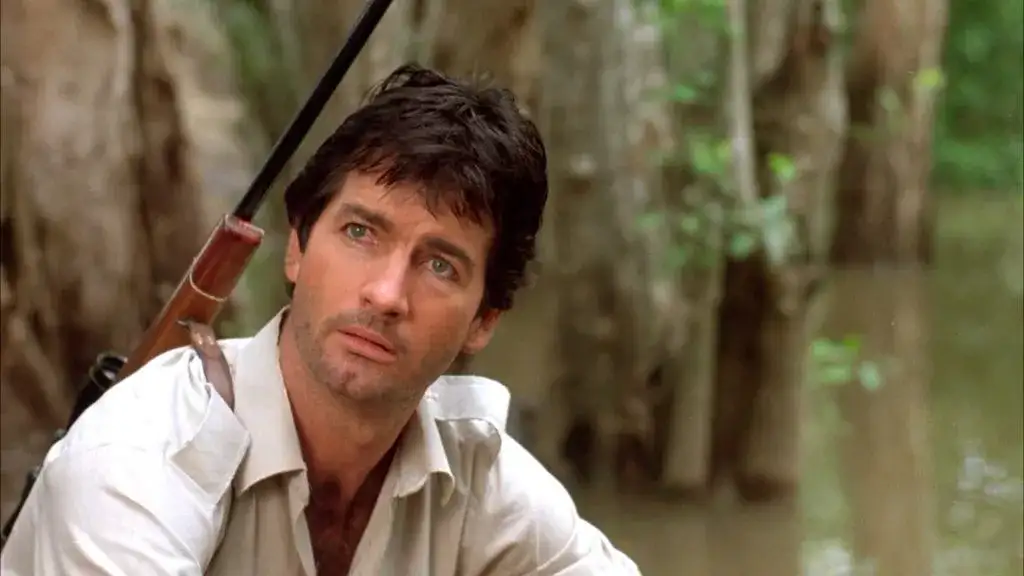
Years before he became well-known as the terrifying villain of Wolf Creek (2005), a young John Jarrett would step into the deep Outback in a very different kind of role.
Instead of a vicious hunter of humans, Jarrett stars as pacifistic Wildlife Ranger Steve Harris, a protector of animals. Mainly the “crocs” that haunt the waters of his isolated riverside town.
However, he’s put in an awkward position when one of the “crocs” under his jurisdiction begins eating people. The first victims (who one could say kind of had it coming) are poachers in the deep jungle, so he’s not under too much pressure.
But the unnaturally large beast soon makes its way downstream to the town’s wharf, leading to the shocking death of a child (in a no-way-they’re-gonna-do-it moment that hits hard due to fantastic editing.) And then the harbour of the nearest big town.
Suddenly, everyone is on Steve’s ass to do something about it. But the crocodile proves to be almost supernaturally cunning and evasive.
Something that the local Aboriginal population (including Walkabout’s Gulpil) warn about, believing the creature to be a “dreaming croc.” An ancient and powerful beast that “no white man can kill.”
Still, after a reward is put out for its capture and “every trigger-happy yahoo in the territory” descends on the area to shoot any “croc” on sight, Steve is forced to take unorthodox action. And he’s helped on his mission by his old flame, pragmatic anthropologist Cathy (Nikki Coghill).

The relationship dynamic between Steve and Cathy is fun to watch and they exchange some snappy dialogue. Though I perhaps could have done without what feels like an obligatory sex scene – Jarrett is too closely associated with Mick Taylor in my mind to make it anything but uncomfortable! But admittedly, it is artfully shot (and Jarrett was actually quite the stud in his youth!)
Like its “creature feature” forebearer Razorback, Dark Age is based on a novel. And, similar to that earlier film, has a robustness that many 80s “Ozploitation” films lack.
The characters feel well-formed, the story well-plotted, its themes well-developed. And, like The Last Wave, it approaches its Aboriginal elements with respect and care.
The film is generally well-shot, with some superbly lit, atmospheric nighttime “croc” hunting scenes that take cues from Razorback. And the mostly convincing animatronic crocodile is wisely sparingly used, the attack sequences taking a note from Jaws and showing as little of the creature as possible.
Initially, the musical score is refreshingly relatively restrained (by 80s standards anyway), relying more on Aboriginal sounds than synths and beats. Although it’s guilty of indulging in the latter more heavily in action scenes as the film goes on (it was the late 80s, so I’ll give the film a pass in this area!)
Score: 7.5/10
Where to Watch Dark Age (1987)
Discover where Dark Age (1987) is available to stream, rent or buy across different platforms and countries.
The Dreaming (1988)
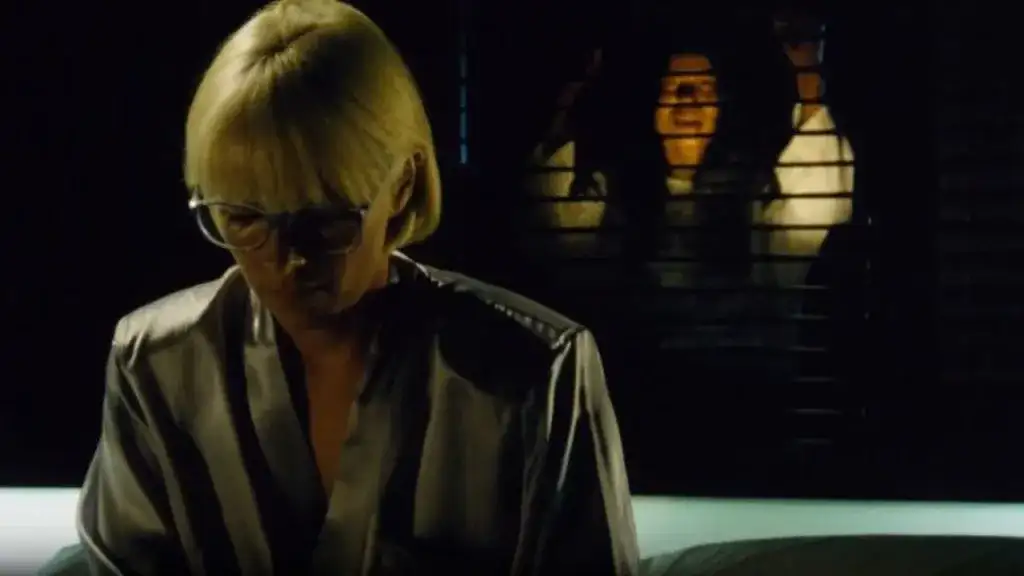
The Dreaming is one of the last notable films with supernatural horror elements produced in Australia before the late 80s Hollywood trend of gritty action/thrillers and/or sci-fi flicks fully took over Aussie cinema. And until “Ozploitation” was somewhat revived, after a decade of dormancy, in the 2000s.
A DVD release of this film described it as being “in the tradition of The Last Wave.” Indeed, it’s almost impossible to talk about The Dreaming without bringing up Peter Weir’s earlier film.
For starters, both movies center a white middle-class protagonist who starts to question their comfortable existence after coming into contact with Aboriginal mysticism. A long-hidden cave filled with tribal artefacts, and the disastrous consequences for removing them, also factors into both stories.
However, where The Last Wave’s chills were more low-key and cerebral, The Dreaming fully leans into supernatural horror. For one, there are jump-scares galore (though reasonably creative and effective.)
And the film is full of outright terrifying sequences. Including one where a ghostly woman claws against a window (pictured above), grungy and disturbing historic flashbacks, and a harrowing climactic scene involving a lighthouse that strays into slasher territory.
Apparently, the film wasn’t always intended to lean so much into horror, as co-writer and original director Craig Lahiff apparently left the production after a “disagreement over whether to take a shock approach or a cerebral one.” That presumably would have hewed it closer to The Last Wave.
And replacement director Mario Andreacchio said years later that “it was originally a script that was tackling, quite strongly, the issue of the past treatment of aborigines.” With Lahiff also commenting that the script “got changed so much I wasn’t interested in doing it.”
Still, what we get still has plenty to chew on regarding Australia’s murky past. And a twist regarding one main character’s true intentions, though less than subtle, makes it clear that the horror still lingers in the present.
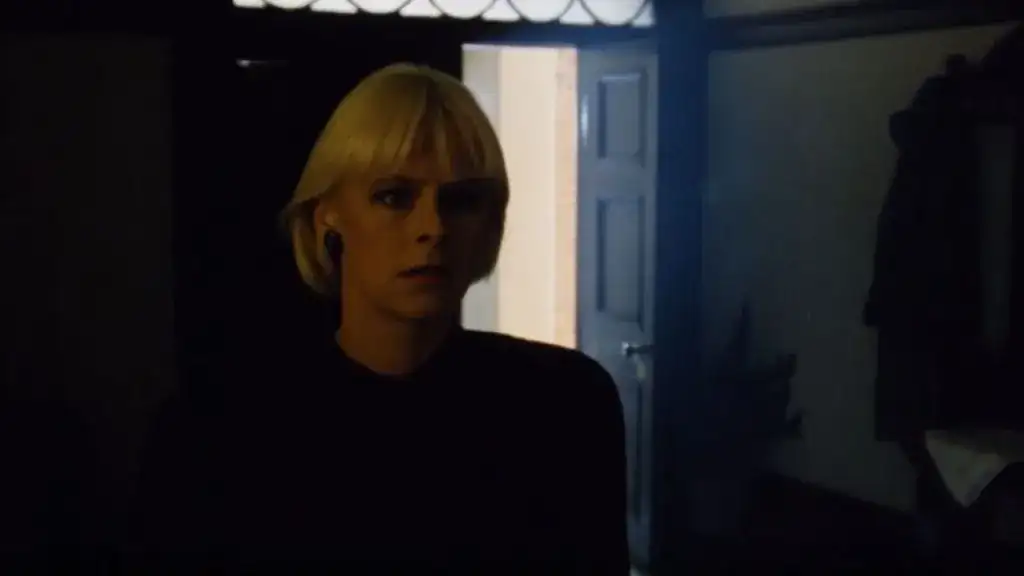
And The Dreaming is very well-lit and shot. The Kubrickian helicopter shots of Kangaroo Island that open and close the film are stunning, and some of the interior scenes are equally as impressive.
The film is also full of some truly striking and eerie visuals, such as the X-ray of a skull suddenly coming to life. And the vision of a spectral whaling ship sailing through green fog.
Penny Cook is engaging and sympathetic as protagonist Cathy, a put-together doctor who descends into a spiral of fear and doubt. Plus, she has an awesome haircut and gets to rock some fabulous 80s fashion (featuring lots of shoulder pads!)
And Arthum Dignam gives serious Aussie Christopher Lee vibes as her intense archeologist father. And more depth to convey than in his other 80s “Ozploitation” horror outing, Strange Behavior (1981).
Elsewhere in the cast, John Noble (The Lord of the Rings, Fringe) makes a brief but welcome appearance as a haughty university professor. And young Aboriginal actress Kristina Nehm turns in a truly haunting performance.
The plot is admittedly a little creaky and unfocused, but the themes, atmosphere, and acting are all solid. The Gothic musical score is also a nice change of pace from the 80s excess of the past few films I saw.
Interestingly, there are some parallels between this and this year’s NZ Gothic horror Mārama. Both deal with spirits, bad omens, and colonizers made rich by whaling facing a reckoning over shameful historic practices.
Score: 7/10
What did you think of my picks? Did I miss any of your favorites? Let me know on Instagram!
Where to Watch The Dreaming (1988)
Discover where The Dreaming (1988) is available to stream, rent or buy across different platforms and countries.