
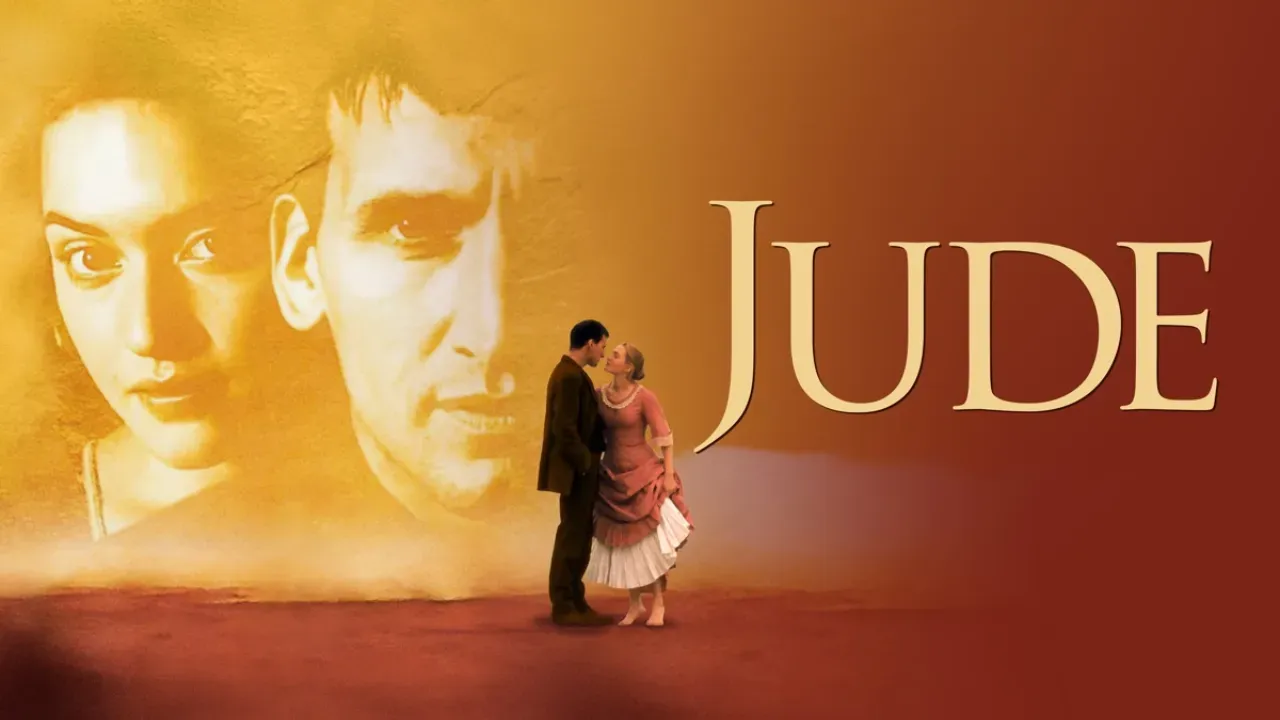
Where to Watch Jude
Discover where Jude is available to stream, rent or buy across different platforms and countries.
Why I took it off the list:
The other day I was reading an article about the Buddhist teaching that suffering is an intrinsic and unavoidable part of life, and how resisting this notion only leads to more suffering. In order to live with serenity, we must accept this unpalatable fact.
While reading, a piece of melancholy yet somehow uplifting music popped into my head. At first I couldn’t place it and was racking my brains, asking myself “Where is that from??”
Suddenly, I was mentally propelled back through time to a memory I had completely forgotten. Restlessly sitting in a hot classroom, I joined in with the choir of other voices begging our high school English teacher to let us watch a movie because it was the last day of the school term and we didn’t want to do any work.
The somewhat intimidating, normally resolute Mrs. Salisbury surprisingly conceded, although with a caveat: she was going to pick the film. We begrudgingly accepted and settled down to watch Jude (1996), which seemed an odd choice as we had never studied the novel it was based on, Thomas Hardy’s Jude the Obscure.
But by film’s end, it became obvious why our teacher had chosen this particular story to show to a bunch of rowdy kids on the last day of school: to deflate us. What starts as an optimistic portrait of a man’s life and loves becomes a cautionary tale of personal expectation vs. social reality, and climaxes with one of the most horrific and tragic scenes you could imagine.
But while that image was forever burned into my young brain, so too was the undeniably beautiful soundtrack. And while I had gradually forgotten both, it’s telling that the latter was the one to resurface first.
So, despite being on more of a comedy vibe recently, and even knowing I was in for a depressing ending, I decided to go back and re-watch Jude to see how I would react to its story and themes 20 years later.
So, let’s dig in!
Review of Jude (1996)
There’s a lot to unpack in Jude. The 1895 source novel charts the full course of an ambitious working-class man’s life through six different stages, marked by the location he finds himself in. So the sections are called ‘At Marygreen’, ‘At Christminster’, etc.
It’s safe to say that it’s quite a saga. So screenwriter Hossein Amini (best known for his sparse adaptation of novel Drive into the celebrated Ryan Gosling film) had the unenviable task of wrangling an expansive story into a more streamlined narrative.
His method was to write out all the scenes from the novel onto cards and decide which were the most essential and which were surplus. It’s a sound strategy and one which has served other filmmakers well when condensing sweeping tomes into something more easily digestible.
But it’s impossible to please everyone, so there are those who took issue with Amini’s omission of some key elements of the book, particularly the more prominent criticism of organized religion.
It’s unclear whether, as with The Golden Compass, this was mandated so as not to offend certain audiences or, more likely, simply because there are already a slew of themes explored in the movie.
Watching the film, it’s hard not to feel that certain sequences could have used some more breathing room, particularly Jude’s childhood and courting of his wife Arabella.
But overall, Amini’s work is commendable. He smartly removes some unnecessary detours from the novel, such as Jude’s divorce from and remarriage of Arabella, to keep the focus where it belongs: on the romance with his great love (and cousin!) Sue Bridehead, and their considerable struggles as pariahs in a hostile society.
And despite going all in on the sustained misery and aforementioned traumatic scene from the later parts of the novel, Amini opts for a less definitive, somewhat more hopeful ending which still invites plenty of debate on the themes Hardy explored.
Winslet Shines and Steals the Film

The scenes ‘At Marygreen’ (particularly the gorgeous black-and-white opening sequence in a barren field, where young Jude feeds crows and is reprimanded by the farmer) are effectíve in establishing the curious and somewhat rebellious nature of the titular character.
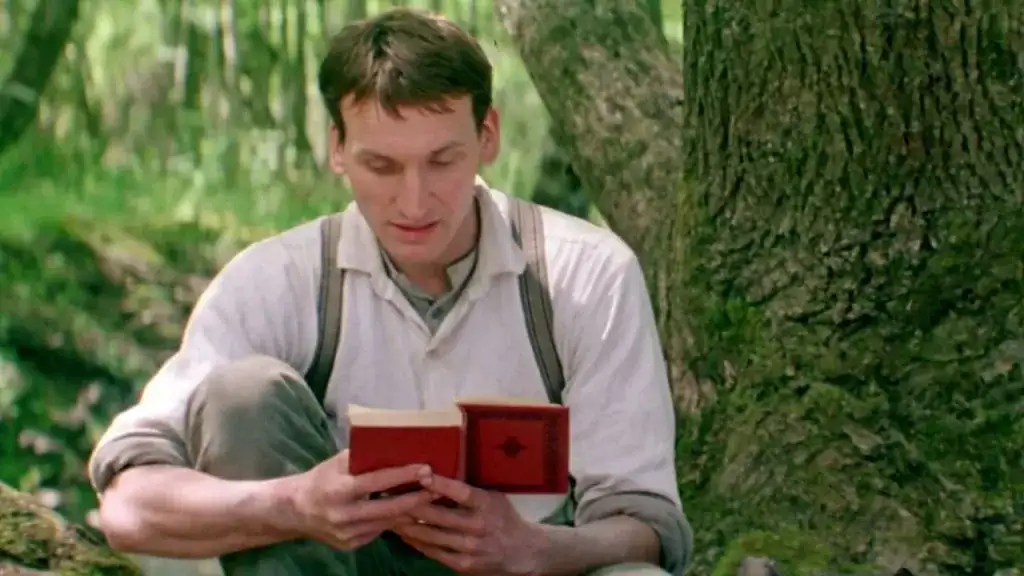
But it’s not until an adult Jude (Christopher Eccleston) makes his way to the university town of Christminster (fictional, but based on Oxford, and largely brought to life on screen by the Gothic streets of Edinburgh) to pursue his scholarly ambitions that the film really captures your attention. That’s because it’s here where he first meets his cousin Sue (Kate Winslet).
Some readers of the novel have complained that the film “made Sue out to be a bit more lively than the book” and take particular umbrage with a scene in a pub where she’s downing pints with the lads and twirling around puffing a cigarette.
(Side note: This setting also features a very young David Tennant in an early role!)
But even among these detractors, the consensus is clear: Winslet absolutely nails this headstrong and outspoken character and brings her to vivid and unforgettable life.
And, although the roles are separated by more than a century, there are clear shades of the free-spirited Clementine that Winslet would later embody in Eternal Sunshine of the Spotless Mind.
She is just simply lovely in the part, particularly in the scenes where Sue and Jude first bond at a fair and on a riverbank. That’s also where the beautiful motif that is so firmly ingrained in my mind comes into play for the first time, a highlight of the excellent score by underrated composer Adrian Johnston.
That’s not to say she’s a slouch when it comes to the dramatic material, as she more than capably transmits Sue’s gradual slide into weariness and then utter despair.
Though he’s somewhat overshadowed by his vivacious co-star, Eccleston does his best to convey the sensitive yet bullish nature of Jude Fawley as he fights to escape his modest background and overcome social barriers to achieve his academic ambitions.
And the always-reliable Rachel Griffiths successfully draws out different shades of the self-centered Arabella, a character thankfully presented as more ambigious and far less devious and ill-intentioned than in the book.
Indeed, the fear of ensnarement by a malicious woman that so scared Hardy is tempered down quite a bit in the film, as is the ‘stick to your lane, or else face divine retribution’ messaging of the novel.
Instead, as well as being a tragic story of a doomed romance, Amini and director Micheal Winterbottom present Jude more as a study of human failings and the unfair barriers that society puts in the way of those seeking upward mobility.
Lessons that still resonate today and make the film more than ripe for a rewatch.
Final score: 8/10