
Where to Watch Late Fame
Discover where Late Fame is available to stream, rent or buy across different platforms and countries.
Why I took it off the list:
We always try to see at least one film at Barcelona’s Americana Film Festival every year, and, purely for the screening time and convenience, picked this.
Well, that’s not entirely accurate: of the titles we whittled down to possibilities, Late Fame stood out due to the presence of the great Willem Dafoe, who always delivers an interesting performance, no matter the material. And, as I’d recently seen him in an earlier leading role, I was on a bit of a Dafoe high!
Also, after her breakout turn in Russian Doll, co-star Greta Lee is on a bit of a hot streak at the moment. I have to shamefully admit I still haven’t seen the widely acclaimed Past Lives – it’s on my list! – but thought she was hilarious in her episode of Seth Rogan’s on-point film industry satire The Studio.
So, let’s dig in!
Review of Late Fame (2025)
Success in the world of the arts is a puzzling and unpredictable thing. This is maybe most visible in the notoriously fickle music and film industries, where an undisputed talent like Rodriguez somehow fades into obscurity.
Or character actors like Amy Madigan who have given memorable supporting performances over decades are finally recognized towards the back end of their careers.
In the literary sphere, there are talented writers like Stephen King or J.K. Rowling (yes, I know she has since gone over to the side of the Death Eaters) who became overnight sensations after publishing their first novel.
Admittedly, both toiled and struggled for years beforehand, but they still found success relatively young and have gone on to have lengthy, robust careers. And are now a multi-millionaire and billionaire, respectively.
Then there are writers like Philip K. Dick and H.P. Lovecraft, who wrote ahead-of-its-time work which didn’t find much critical acclaim or commercial success during thier lifetimes.
Both died, in relative poverty, before Blade Runner found its audience or Cthulhu plushies started lining toy shop shelves. And after years of struggle with mental and physical illnesses.
But if novelists can have a rough ride, it’s nothing compared to those who feel compelled to express themselves through poetry.
There are definitely exceptions who have managed to spin their verses into commercial success, but usually by supplementing them with other mediums.
However, I think it’s a well-known fact that most poets, usually by their nature sensitive souls who don’t have much business savvy, seriously struggle. Unless they manage to find a dogged agent or rich benefactor.
And studies have shown that poets, tragically, tend to die much younger than other types of writer. Not to mention the love troubles they have while alive, as depicted in Jane Campion’s brilliant biopic Bright Star, where Kerry Fox’s character memorably tells her daughter: “Mr. Keats knows he cannot like you, he has no living and no income.”
And, among those who survive, the sad fact is that many poets, realizing the financial impracticality of their calling, throw in the towel and conform to whatever secure work (menial or otherwise) they can get their hands on in order to keep on living somehow, while their creativity and hope fades.
In Late Fame, the latter fate has befallen Ed Saxberger (Dafoe), who we meet as a lowly postal office worker, sorting letters into different slots. He then shambles home to his lonely apartment, has a tuna sandwich, wearily gets into bed and turns off the lamp. And rinse and repeat the next day, and the day after that.
But on one of many such monotonous days, he returns home, only to find an anxious but eager young man, Meyers (Edmund Donovan) waiting outside his building. He excitedly asks him if he’s “The Edward Saxberger.”
Ed, wary, asks, “What’s this about?” Meyers explains that he discovered a barely published book of poetry that Saxberger had written in the 70s and that it was a revelation to him. And when he realized that this potent poet was living in the same New York neighborhood, he just had to meet him.
Ed is initially dismissive, insisting that his poetry days were a long time ago. But Meyers persists, saying that the book has really inspired him and his tightknit group of fellow young artists, and they’d all love to meet him.
Dafoe And Lee Both Give Atonishing Performances
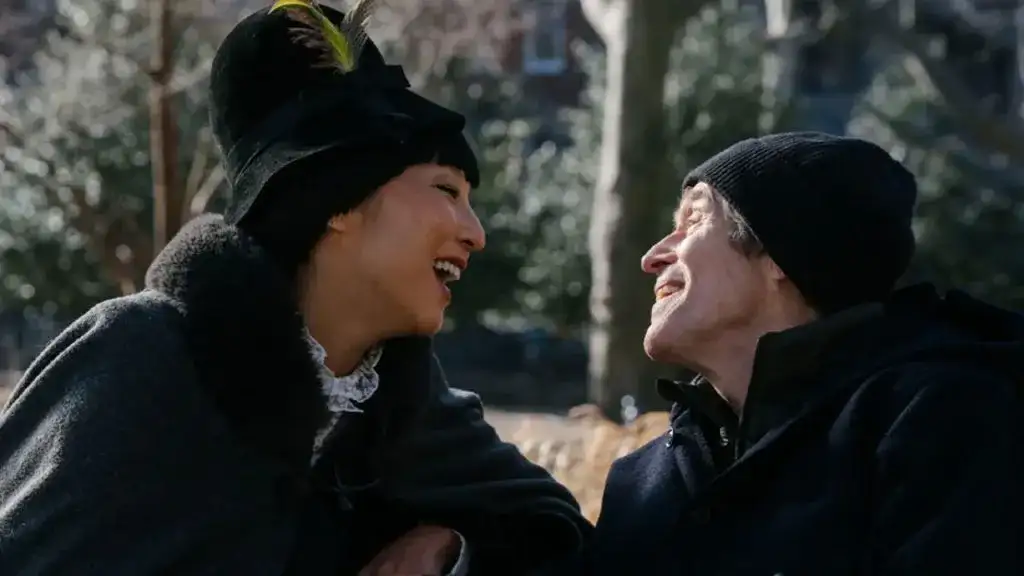
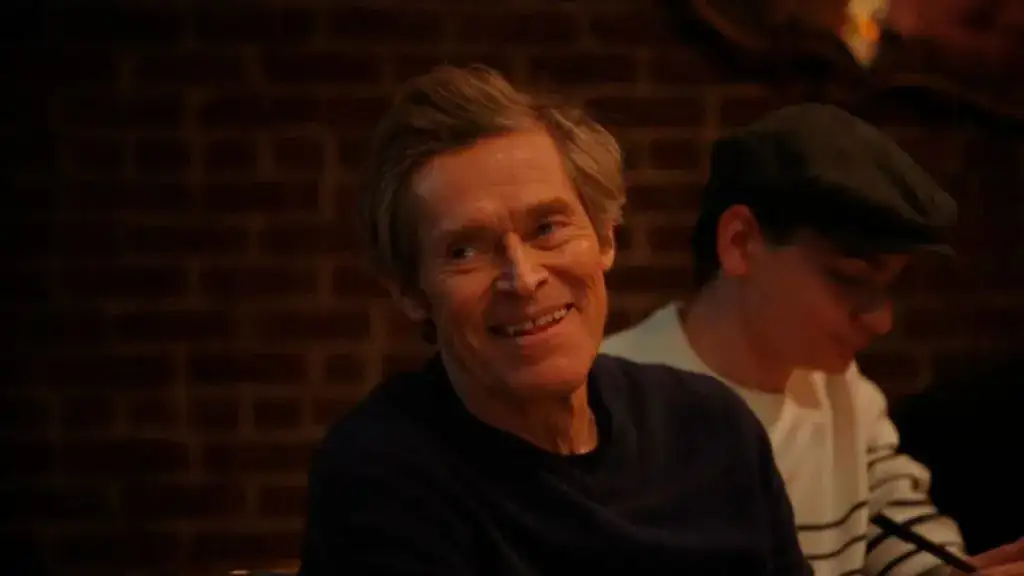
This is where the miracle of Willem Dafoe’s performance starts to show itself, as the actor suddenly transforms the permanent grimace we’ve seen on Ed so far into a slight smile, then a full toothy grin as Meyers invites him to attend one of the group’s brainstorming sessions.
But Ed’s brow furrows once again. He politely thanks Meyers for the invite, but turns down the offer and walks off. Meyers, persistent, calls out that if he changes his mind he can always find the group at a local café they frequent.
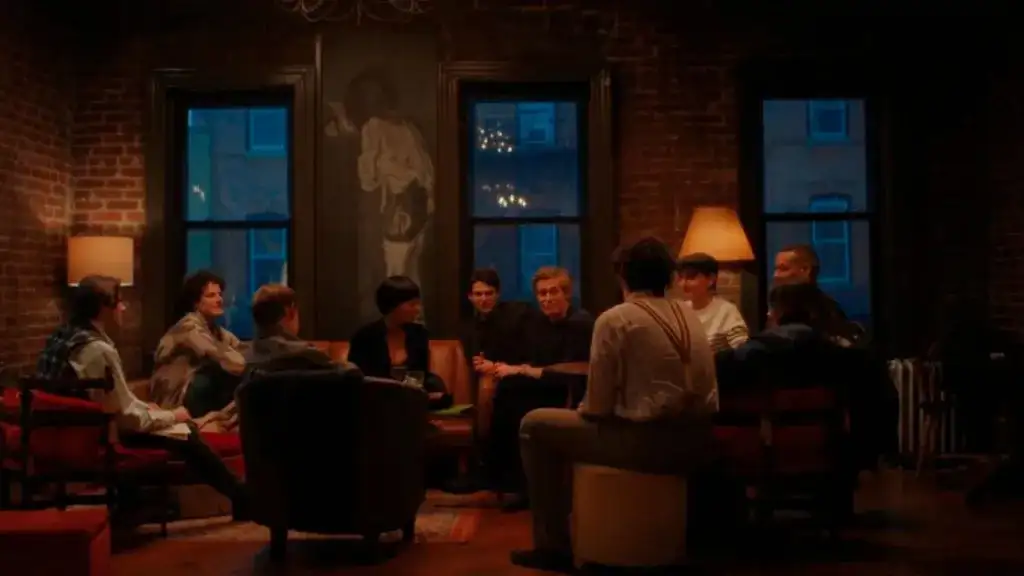
Predictably, after pulling out some old newspaper clippings praising his only published work, Ed does eventually decide to pay a visit to the café. And he’s visibly astonished when these Gen Zers greet him as if he’s some kind of unjustly unrecognized prophet.
During the meeting, you can see the light and hope come back into Saxberger’s eyes as he fields questions from the group of young men. Did he know other artists who frequented the East Village at the height of the counterculture movement? Ginsberg? What about Burroughs?
Saxberger’s grin only widens as he hears the young creatives discuss how to get their work out there, in a ‘pure’ way, unlike the despised Insta influencers at a neighbouring table. And he suggests a good old-fashioned recital.
Meyers is immediately onboard and has a lightbulb moment: Saxberger should also participate, he’d be their star attraction, and read a newly penned poem.
He initially balks at the idea: he hasn’t written a word in years. But his hesitation wavers when he’s introduced to the sole female member of the group, Gloria (Lee), a theatre actress.
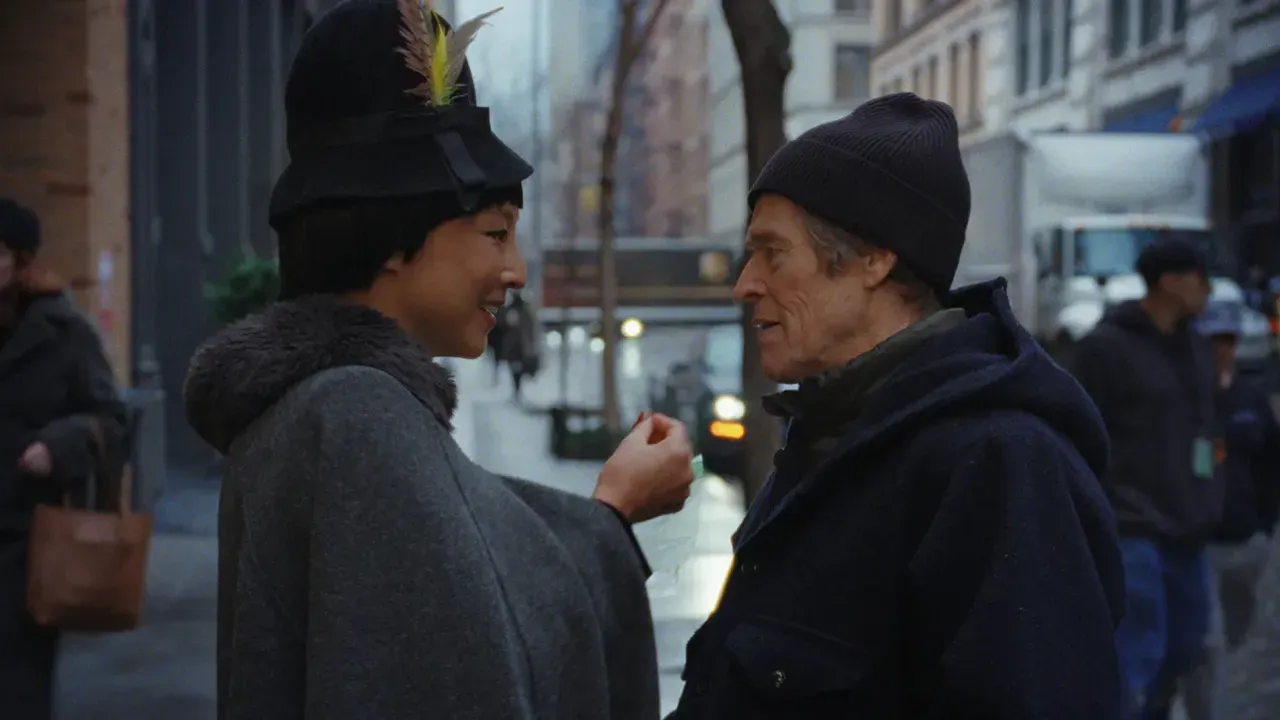
She waltzes into the space with a commanding presence, looking like a modern spin on a flapper, and theatrically announces her arrival. Saxberger is immediately captivated by this bold, mysterious woman and soon an unlikely bond forms between them. She could be the muse he sorely needs.
It’s easy to see why he’s bewitched by her: Lee is beguiling as this larger-than-life character, particularly in a show-stopping cabaret performance in a bar, and entertaining in her ‘Yes, I’ve been to Paris many times, darling. Have you?’ mannerisms.
But, in an impactful scene where Saxberger pays Gloria an impromptu housecall, her persona is revealed to be just that, a persona. And both Ed and us the audience get the pleasure to see Lee expertly turn her from an almost-caricature to a real, messy person.
It’ll be a real crime if both Dafoe and Lee are not nominated for awards next season, as Dafoe gives arguably a career-best performance in a vast parade of astonishing turns. And Lee is incredibly skilful in showing the different sides of Gloria Gardener, if that is her real name, as one character quips.
The Ending – Possible Spoilers!
Once he’s mulled over penning some new work, and even with Gloria’s influence, Ed finds that he’s only able to come up with a single phrase and becomes increasingly frustrated.
Meanwhile, it’s clear that the new-found appreciation for his old work has gone to his head a bit when he lambasts his working-class drinking buddies in their local dive bar for not being up to his intellectual level.
But his ego is deflated a bit when he has a meeting with a publisher (Jake Lacy, who so memorably played a douchebag in White Lotus season 1, and pretty much repeats the same feat here), who’s only interested in the memoir that Meyers promised him without Ed’s knowledge.
The day before the recital, Ed finally confesses that hasn’t been able to conjure anything new into being, to the group’s dismay, as flyers announcing the rediscovery of Saxberger, presenting new work, have already gone out.
But Meyers quickly steps in, saying it’s fine, because he was never discovered in the first place by pretty much everyone who will be in the audience. So they formulate a back-up: Gloria is to read one of Saxberger’s old poems, to which Ed concedes.
But things don’t exactly go to plan on the big night: Gloria is a no-show as the first artist takes the stage, and the group, especially Ed, starts panicking. When she does eventually stagger into the green room, she appears to be heavily intoxicated and in no state to perform.
However, when her first act is up next, she gets to her feet, stumbles over to the curtains and then something miraculous appears to happen. As the point of her high-heel taps the wooden floor, she straightens up, tranforms into the same Gloria Ed met at the café, and confidently strides over to a stool centre-stage.
After draping herself over the stool, she proceeds to give a lucid, precise, impassioned monologue about a woman begging for the return of her dead child. And Lee, as Gloria, is astonishing, especially as we’ve just seen her in a rather different light.
But when she steps back behind the curtain, she almost collapses and has to be carried to a sofa, and it’s clear that this time she’s not getting up. So a reticent Ed has no other choice but to get up on stage.
Once he’s on the stool and begins to hesitantly read, we see him at a great distance, flanked by the vast emptiness of the stage, the silhouetted heads of audience members below.
But once he starts to find his footing in this long-lost experience, the camera cuts closer, and then closer again, until, in close-up, we see Saxberger start to really engage with his poem once again. And Dafoe’s weathered face conveys all the joy and sadness he felt when writing the words all those years ago.
After the recital is over, screenwriter Sammy Burch, who also penned the excellent Natalie Portman/Julianne Moore vehicle May/December from master filmmaker Todd Haynes, wisely keeps the fates of the characters vague, while still suggesting where they might be headed.
This includes Ed, who, after the show, is approached by the youngest member of the group, which in this scene is revealed to be a bit more devious than at that first meeting (they would probably fit right in with the morally dubious club in Donna Tartt’s excellent novel The Secret History.)
Winn (Luca Padovan) is eager for Ed to mentor him. But after the aforementioned revelation, Ed realizes that all this kid wants is the association of the mythic persona of Saxberger the poet, something long lost.
And so he walks away, unsure if his reading is going to make an impact, and rejoins his old friends in the dive bar.
Final score: 10/10
Late Fame (2025): Worth Watching?
Yes, Late Fame is a beautiful, moving and excellently acted film about the weight of regrets and a life unlived, and the dangers of ego and losing yourself in a persona. And it should resonate with a lot of people despite its niche art world trappings.
It would actually make for a great Double Feature with The Great Lillian Hall, as both deal with artists in their later years struggling with their craft, although of course Jessica Lange’s character has had a great deal more success in her calling than Dafoe’s.
One final, and fascinating, observation: Late Fame is based on the novella of the same name by Austrian author Arthur Schnitzler, which was written all the way back in 1895, and set in the Vienna arts scene.
But it’s incredible that, with just a few tweaks (Eduard becomes Edward, Fräulein Gasteiner is Gloria Gardener, the setting is changed to present day New York), the story is as relevant and resonant today as ever.
And the most, almost mind-warpingly ironic piece of trivia of all? Schnitzler’s book was never published during his lifetime, only rediscovered among his writings over a century later, and finally issued in 2014, before the movie adapation then came along.
Truly a case of art imitating life imitating art if there ever was one.